Advertisement
Only 3% of GBV stories in Kenya focus on perpetrators – Report
Saturday 25th October, 2025 08:32 AM|
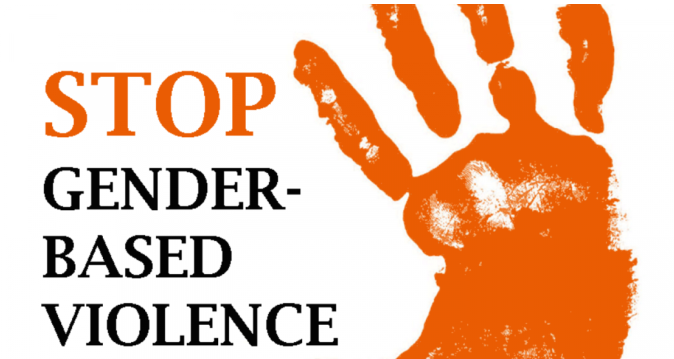
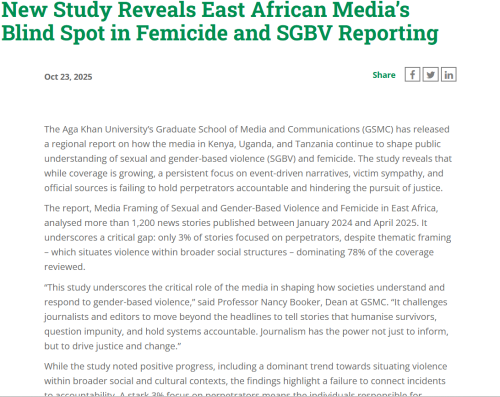
A new regional study by the Aga Khan University’s Graduate School of Media and Communications (GSMC) has revealed that only 3 per cent of media stories on gender-based violence (GBV) in Kenya focus on perpetrators, exposing a major gap in accountability reporting.
The report, titled Media Framing of Sexual and Gender-Based Violence and Femicide in East Africa, analysed more than 1,200 stories published between January 2024 and April 2025 across Kenya, Uganda, and Tanzania.
It found that 78 per cent of the coverage adopted a thematic framing, yet most stories remained event-driven, heavily reliant on official sources, and failed to interrogate justice outcomes.
“A stark 3% focus on perpetrators means the individuals responsible for violence often remain out of sight in media narratives, especially in follow-up reporting. Only 11% of stories amplified survivor voices, despite survivors being central to the narrative of violence,” read the report.
You Might Also Like



“Kenya accounted for more than half of the regional coverage (54%), followed by Tanzania (28%) and Uganda (18%), suggesting a positive impact from the institutionalization of gender desks and targeted newsroom training.”
Kenya leads in coverage
According to the findings, Kenya accounted for 54 per cent of the regional coverage, followed by Tanzania with 28 per cent and Uganda with 18 per cent. Researchers attributed Kenya’s lead to the institutionalisation of gender desks and targeted newsroom training initiatives that have encouraged more frequent reporting on GBV and femicide.
However, the study noted that while Kenyan media outlets publish more stories, they often centre on victims rather than perpetrators or systemic failures. Only 11 per cent of stories amplified survivor voices, while coverage of investigations, court proceedings, and sentencing remained minimal.
Lead researcher Hesbon Hansen Owilla said the invisibility of perpetrators in news narratives perpetuates impunity and weakens deterrence. “When media stories fail to follow through beyond the initial incident, accountability gets lost. This allows perpetrators to remain faceless and unchallenged in public discourse,” he said.
Call for gender-sensitive journalism
The report, conducted under GSMC’s Advancing Gender Equality in Media and Civil Society in East Africa (AGEMC-EA) project, urged newsrooms to adopt gender-sensitive editorial practices. It recommended that media houses institutionalise gender desks, train journalists on survivor-centred reporting, and strengthen collaborations with academia, civil society, and policymakers.
Professor Nancy Booker, Dean of GSMC, emphasised the critical role of the media in shaping public understanding of GBV. “The media must move beyond sympathy to accountability, to tell stories that humanise survivors and question impunity,” she said.
The study also observed a growing awareness among journalists that sexual and gender-based violence is a societal problem rather than a series of isolated cases. It called the report a wake-up call for East African media to reimagine storytelling, centre the right voices, and connect incidents to justice systems to drive lasting change.
Regional effort toward accountability
The report positions itself as part of a broader effort to strengthen media’s role in advancing gender equality across East Africa. GSMC plans to continue engaging editors, reporters, and journalism trainers to build capacity for nuanced reporting on GBV and femicide.
Researchers concluded that meaningful progress will depend on how effectively media outlets integrate accountability and gender perspectives into everyday reporting — not only when tragic incidents make headlines.
Author
Latest News








Advertisement
More on News