Advertisement
KNBS GDP 2026: Lower interest rates drive credit growth across key economic sectors
Saturday 11th July, 2026 11:27 PM|

Kenya’s economic expansion in the first quarter of 2026 was not only driven by tourism, construction and manufacturing growth but also by a notable increase in credit uptake across key sectors, highlighting the growing role of lower borrowing costs in supporting investment and business activity.
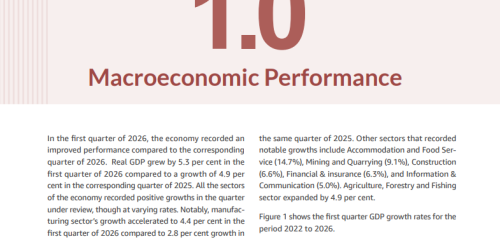
According to the latest Quarterly Gross Domestic Product (GDP) Report released by the Kenya National Bureau of Statistics (KNBS), the economy expanded by 5.3 per cent in the first quarter of 2026, up from 4.9 per cent during the same period in 2025.
The report points to improved access to credit and declining lending rates as important factors behind the stronger economic performance. As businesses took advantage of cheaper financing, sectors such as construction, manufacturing and financial services recorded solid growth, reinforcing the link between credit availability and economic expansion.
For businesses, investors and entrepreneurs, the findings offer fresh insight into how Kenya’s interest rates, business loans and access to financing continue to shape investment trends and economic growth.
You Might Also Like



“The financial and insurance activities grew by 6.3 per cent in the first quarter of 2026 compared to a growth of 5.3 per cent in the corresponding quarter of 2025,” KNBS said in the report.
The improved performance came as lending conditions eased following reductions in the Central Bank Rate, encouraging businesses and households to borrow, invest and spend.
Lower borrowing cost, higher credit growth
One of the clearest signals of improving financial conditions was the decline in commercial lending rates.
KNBS reported that the average lending rate fell from 15.77 per cent in March 2025 to 14.70 per cent in March 2026, making credit more affordable for businesses seeking expansion capital and working capital financing.
The reduction followed a series of policy adjustments by the Central Bank of Kenya aimed at stimulating economic activity through lower borrowing costs.
In many economies, lower interest rates encourage businesses to invest in new projects, purchase equipment, hire workers and expand operations. Kenya appears to be experiencing a similar trend as credit flows increasingly into productive sectors of the economy.
The construction sector offers one of the strongest examples.

According to KNBS, credit extended to the sector rose significantly from Ksh157.3 billion in the first quarter of 2025 to Ksh200.6 billion in the first quarter of 2026.
The increase coincided with stronger construction activity, with the sector growing by 6.6 per cent during the quarter.
The report also noted higher consumption of cement and increased imports of construction materials, suggesting that developers and contractors are responding to improved financing conditions.
The growth in construction credit is particularly important for Nairobi, Kiambu, Machakos and other rapidly urbanising counties where demand for housing, commercial buildings and infrastructure projects continues to rise.
Manufacturing and financial services boom
Kenya’s manufacturing sector also benefited from improved credit conditions, reinforcing its role as a key pillar of industrial growth and job creation.
KNBS reported that credit to the manufacturing sector increased to KSh 588 billion during the review period, reflecting growing confidence among manufacturers despite global economic uncertainties.
The sector expanded by 4.4 per cent compared to 2.8 per cent in the first quarter of 2025.
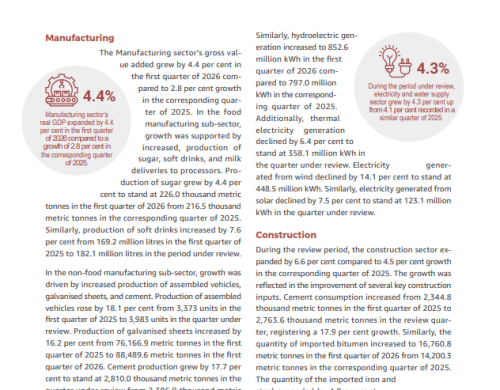
“Manufacturing sector’s growth accelerated to 4.4 per cent in the first quarter of 2026 compared to 2.8 per cent growth in the same quarter of 2025,” the report stated.
Higher production of sugar, soft drinks, cement and assembled vehicles helped support the sector’s recovery, while improved access to financing enabled businesses to invest in production capacity and operations.
The broader financial sector also recorded stronger performance as demand for loans increased.
As lending rates decline, banks and other financial institutions often experience higher demand for credit products, creating a positive cycle that supports investment, employment and economic activity.
The KNBS report suggests that lower borrowing costs are becoming an increasingly important driver of Kenya’s economic growth. While sectors such as tourism and agriculture continue to play a vital role, expanding credit access is helping businesses unlock new investment opportunities and accelerate expansion plans.
For small and medium-sized enterprises, which account for a significant share of jobs in Kenya, lower financing costs could provide a critical boost at a time when businesses are seeking to recover from recent economic pressures.
With lending rates easing, credit growth accelerating and investment activity strengthening, the latest KNBS data indicates that improved access to finance is emerging as one of the key engines powering Kenya’s economic recovery in 2026.
Author
Latest News






Advertisement
More on Business