Advertisement
Why WHO’s new infertility guidelines are wake-up call for modern families
Saturday 29th November, 2025 07:46 AM|

In today’s fast-paced world, many couples dream of starting a family “later” after the career is built, the house is bought, and life feels stable.
Yet the World Health Organisation has just released its first-ever comprehensive Guideline for the Prevention, Diagnosis and Treatment of Infertility (2025), and its message is blunt: one in six people of reproductive age will experience infertility in their lifetime.
That’s roughly 17.5% of the global adult population. For modern families who keep pushing parenthood down the timeline, these evidence-based recommendations are nothing short of a wake-up call.
Infertility is officially defined by WHO as “a disease of the male or female reproductive system” marked by the failure to achieve pregnancy after 12 months of regular unprotected intercourse.
You Might Also Like

Importantly, the guideline stresses that infertility can stem from female factors, male factors, both, or remain unexplained – yet women still carry most of the blame and stigma. As the document states, “women are more often blamed, and male factors are neglected.”
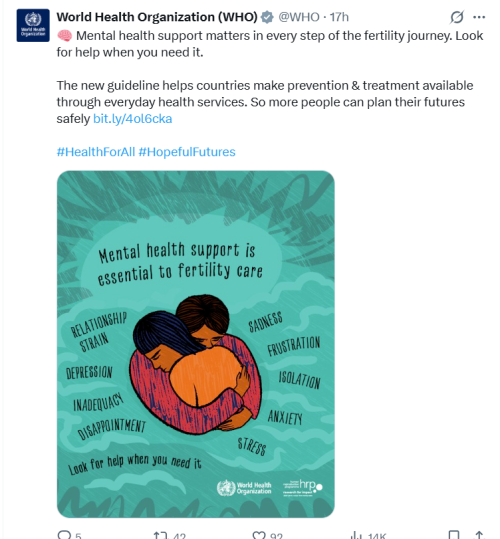
It also highlights the heavy toll: anxiety, depression, relationship strain, social exclusion, and, shockingly, up to 36% of women with infertility face intimate-partner violence.
Understanding the risks modern couples often overlook
The most eye-opening part for today’s thirty- and forty-somethings is the emphasis on prevention and early action. Age remains the single biggest predictor of fertility decline.
The guideline urges countries to provide clear, low-cost information to the general public about age-related fertility decline, lifestyle risks, and when to seek help.
“For the general population of reproductive age, WHO suggests providing information about fertility and infertility using low-cost strategies or whenever there is an opportunity,” the document notes.
Translation: schools, workplaces, and clinics should normalise honest conversations about fertility, including its gradual drop after 32 and sharper decline after 37 for women, and the slower but still notable decline in men after 40.
Lifestyle risks familiar to many urban professionals are highlighted clearly. Smoking, excessive alcohol, poor diet and obesity all increase infertility risk.
The guideline re-emphasises WHO’s recommendation that every healthcare visit include brief advice to quit tobacco, reminding people that “use of tobacco, particularly smoking, is associated with a higher risk of infertility” and that the risk is higher in women.
Untreated sexually transmitted infections remain another preventable cause of infertility, yet many young adults still delay testing or treatment, often due to stigma or misinformation.
Making infertility care fair
When couples do face infertility, WHO calls for streamlined, cost-effective care. It warns against long cycles of expensive tests without evidence-based justification and insists that mental health support be integrated into care from the start. For treatment, the recommendations are notably practical.
Letrozole is now preferred over older drugs for PCOS-related anovulation. For unexplained infertility, “expectant management”, trying naturally with lifestyle guidance, should come before invasive procedures. IVF, long seen as the default solution for many, is repositioned as a third-line option in several cases.
This shift could significantly reduce treatment costs for families worldwide. But it also demands that health systems provide competent counselling, transparent pricing, and protection from unregulated clinics and miracle cures that often prey on desperate couples.
Kenyan view on infertility
However, in Kenya, infertility is deeply intertwined with cultural, social, and religious norms that prioritise parenthood, especially motherhood, as a cornerstone of identity, marital success, and family legacy, leading to profound stigma that disproportionately burdens women.
Viewed not merely as a medical condition but often as a curse, witchcraft, or divine punishment, childlessness invites ridicule, isolation, and even violence. Studies in Kisumu County reveal that infertile women face verbal abuse, accusations of barrenness, and familial pressure for men to take second wives, while up to 36% endure intimate partner violence.
This pronatalist worldview, rooted in communal African traditions, results in high out-of-pocket costs for secretive treatments, delays in seeking professional care, and emotional tolls like depression and divorce.
Despite affecting an estimated 4.2 million Kenyans, many turn to traditional healers or religious figures amid misinformation, exacerbating a “hidden epidemic” of shame.
However, emerging advocacy, such as the Merck Foundation’s “More Than a Mother” campaign partnering with First Lady Rachel Ruto, signals a growing push to reframe infertility as a shared health issue, urging education and policy reforms like the recent ART Bill to foster empathy and accessibility.
A wake-up call modern families can no longer ignore
Perhaps the strongest message to modern households is the reminder that biology does not negotiate with career timelines or personal milestones.
As Dr James Kiarie, head of WHO’s contraception and fertility care unit (cited in the guideline acknowledgements), and the broader WHO have stressed, “By acting urgently, countries have an opportunity to respond to the need for service and mitigate the many inequities in the availability, accessibility, acceptability and quality of fertility care.”
For couples today, the takeaway is both simple and urgent: learn your fertility facts early, make basic healthy choices, and don’t assume time is unlimited.
If you’re over 35 and have tried for six months, or younger and have tried for a year, seek evidence-based help without shame or delay.
The WHO has finally placed infertility firmly on the global reproductive-health agenda. Modern families ignore these guidelines at their own peril and at the peril of the children they hope to have.
Author
Latest News








Advertisement
More on Lifestyle