Advertisement
16 Days of Activism: Understanding the types of digital abuse women face online
Friday 05th December, 2025 08:32 AM|

As Kenya joins the world in marking the 16 Days of Activism against Gender-Based Violence, one truth has become impossible to ignore: the internet, once celebrated as a great equaliser, has become a new battlefield where women and girls face violence every single day.
Digital abuse is not “less real” than physical violence; it destroys reputations, mental health, safety, and sometimes lives. It follows victims into their homes, phones, and workplaces, with no closing time and no safe corner to hide.
The many faces of digital violence
The forms this violence takes are many, and every Kenyan woman who has ever received an unwanted message at 2 a.m. knows at least one of them.
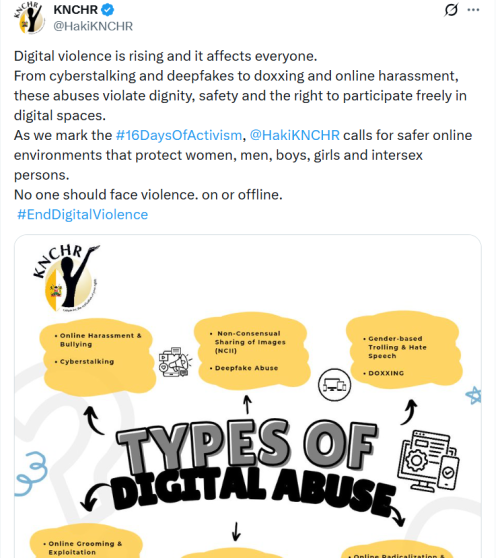
“Digital violence is rising, and it affects everyone. From cyberstalking and deepfakes to doxxing and online harassment, these abuses violate dignity, safety and the right to participate freely in digital spaces. As we mark the #16DaysOfActivism, @HakiKNCHR calls for safer online environments that protect women, men, boys, girls and intersex persons. No one should face violence. on or offline,” read the HakiKNCHR X post in part.
You Might Also Like



Online harassment and bullying are among the most common, including repeated insults, threats, body-shaming, and humiliating comments sent through WhatsApp, Instagram, Twitter, TikTok, or Facebook.
Cyberstalking involves someone constantly monitoring a woman’s online activity, tracking her location through shared posts or apps, sending repeated messages even after being blocked, or creating fake accounts to watch her.
Non-consensual sharing of images (NCII) is another widespread form of abuse. Private or intimate photos or videos are shared without consent, often by current or former partners, to shame, punish, or silence the victim.
Locally, this is known as “kukiachia kwa group” or “kuweka trends.” Deepfake abuse, gender-based trolling and hate speech, doxxing, online grooming, impersonation, digital surveillance in relationships, cyber-blackmail, recruitment for violence, and exclusion through digital barriers are further examples of how women are targeted online.
These twelve forms are not theoretical. They happen every day in Nairobi, Mombasa, Kisumu, Eldoret, and even the smallest rural trading centres where a woman has access to a smartphone. A leaked bedroom photo can reach 50 WhatsApp groups in under an hour. A threatening message can arrive while a woman is in class, at work, or putting her children to sleep.
The impact on mental health, jobs, marriages, and personal safety is immediate and often permanent.
Legal gaps
The 16 Days of Activism remind us that digital abuse is gender-based violence. It is not “just the internet.” It is not something women should “ignore” or “stop posting photos” to avoid. The responsibility lies with the abuser, never the victim.
Yet, despite the growing prevalence, many cases go unreported due to fear, stigma, and pressure for informal resolution. Police officers and institutions are still adapting to technology-facilitated crimes, and laws often lag behind the pace of online abuse.
During these 16 days, and every day after, there is a need for stronger laws, faster police response, better training for officers handling technology-facilitated cases, and real consequences for perpetrators. Let platforms be forced to act within hours, not weeks, when reports are made. Let schools teach digital safety the same way they teach road safety.
Empowering women online
Most of all, let every Kenyan woman know: you are not alone, it is not your fault, and your voice—even online—matters. Awareness campaigns, community engagement, and survivor-friendly reporting mechanisms must go hand in hand with enforcement.
Technology can empower women, but only when backed by accountability, strong institutions, and a society that refuses to tolerate abuse in any form.
These 16 Days of Activism are a call to action for all Kenyans to recognise digital abuse as serious, pervasive, and preventable, and to ensure that the online space is as safe and respected as the physical world.
Author
Latest News








Advertisement
More on Lifestyle