Advertisement
NSE drops trade size limits, opening doors for small investors
Tuesday 29th July, 2025 02:54 PM|

The Nairobi Securities Exchange (NSE) is set to usher in a new era for retail investors with the introduction of single-unit trading.
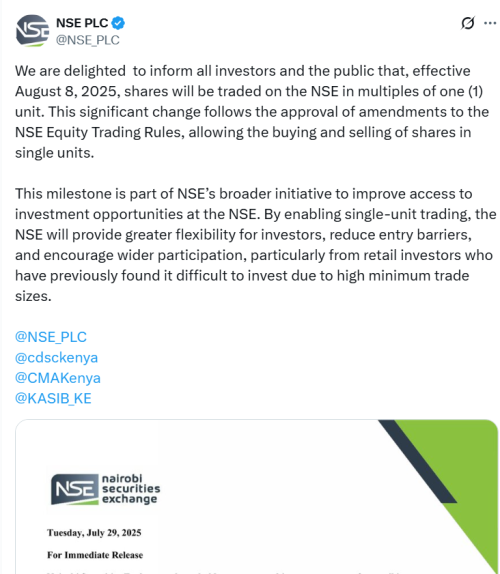
Starting August 8, 2025, investors will be allowed to buy and sell shares in single units, a shift from the previous requirement of trading in multiples of 100, according to an NSE statement posted on their X dated July 29, 2025.
The change follows the approval of amendments to the NSE Equity Trading Rules and is part of a broader push to make the market more accessible to ordinary Kenyans.
The move eliminates the Odd Lot Board, which previously handled trades of less than 100 shares, often at unfavorable prices.
You Might Also Like


Under the new framework, the official daily closing price of a listed equity will only be determined if at least 100 shares or units are traded during a session—a measure aimed at maintaining price stability and aligning with international trading norms.
Easier entry
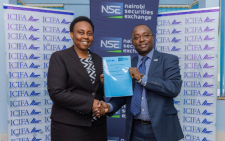
NSE Chief Executive Officer Frank Mwiti said the policy change is central to the exchange’s long-term plan to grow investor participation. “We are pleased to take this significant step towards enhancing retail investor participation in our market.
It aligns with our vision of increasing the number of active investors to 9 million by the year 2029,” he said in a statement.
The NSE’s latest move comes against the backdrop of a rapidly expanding retail investor base. A 2023 African Development Bank study reported a 300% increase in retail participation over a five-year period.
More recently, figures from 5paisa.com (July 24, 2025) show that the number of NSE shareholders surged to over 159,000 in one quarter, up from 39,201—a signal of shifting dynamics from institutional dominance to broader retail activity.
Analysts say single-unit trading is likely to encourage more first-time investors, particularly young people using digital platforms, and could lead to greater market liquidity.
Market reform
The rollout comes at a time when Kenya’s economy is showing strong signs of recovery, with the African Development Bank reporting a 5.2% GDP growth in 2023, driven by strong performances in agriculture and services.
The NSE’s reforms are expected to complement national economic goals by drawing more domestic resources into the formal financial sector.
“This development reinforces our efforts to deepen the market and support the growth of retail investor participation, while also aligning with global best practices in equity trading,” Mwiti added.
As Kenya’s principal securities exchange, the NSE plays a key role in mobilising capital. It is a full member of the East African Securities Exchanges Association, the World Federation of Exchanges, and the UN Sustainable Stock Exchanges Initiative, and it operates under the Capital Markets Authority’s oversight.
Author
Latest News






Advertisement
More on Business