Advertisement
How Africa risks becoming AI colony as US and China tighten global control – report
Saturday 04th July, 2026 11:53 PM|
Africa risks becoming an artificial intelligence (AI) consumer rather than a creator unless governments urgently invest in computing infrastructure, local talent and AI governance, according to a landmark United Nations scientific report that warns the world’s most powerful AI technologies are increasingly concentrated in the United States and China.
The warning is contained in the Preliminary Report of the Independent International Scientific Panel on Artificial Intelligence, released in July 2026. The report argues that the emerging AI divide is no longer simply about access to technology but about who has the power to build, govern and shape the future of artificial intelligence.
“The AI divide is not just about access, but about capacity to influence artificial intelligence development,” the report says. It warns that countries relying entirely on foreign AI systems risk losing control over standards, safeguards and technologies that will increasingly shape their economies and societies.
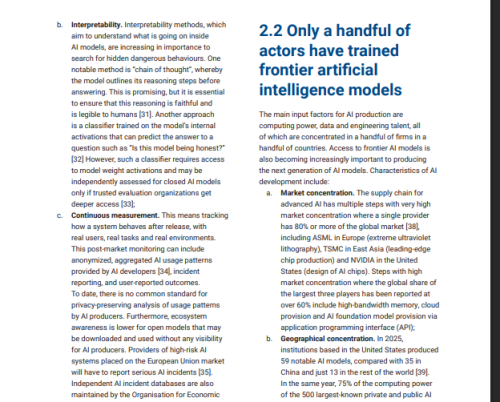
The report paints a stark picture of global concentration. It says the United States now hosts approximately 75 per cent of the world’s top AI computing power, while China accounts for another 15 per cent.
You Might Also Like


Together, the two countries dominate the development of advanced AI models, leaving the rest of the world competing for a small share of the industry’s infrastructure and expertise. Beyond hardware, the report notes that AI production is increasingly controlled by a handful of private technology companies, with 91 per cent of notable frontier AI models in 2025 originating from the private sector.
Such concentration, it warns, could shift wealth from labour to capital while giving a few firms unprecedented influence over data, innovation and public policy.
For Africa, the implications are particularly significant. The report says current AI systems reflect only a limited share of the world’s more than 7,000 languages and cultural contexts, leaving much of Africa underrepresented in the digital future.
“Most of the world’s languages and cultures remain underserved,” it states, adding that targeted investment is needed to ensure underrepresented communities are included in AI development.
It also warns that many countries are being left out of global AI decision-making altogether. According to the report, 118 countries, mostly in the Global South, are not actively participating in major international AI governance discussions, while fewer than one-third of developing countries have adopted national AI strategies.
Without investment, the consequences could extend beyond technology.
“Countries that rely on foreign models, cloud infrastructure and data pipelines may gain access to AI while losing practical control over its standards, safeguards and local fit,” the report warns.
The panel argues that digital sovereignty will increasingly depend on domestic computing capacity, AI research, skilled professionals and regulatory expertise.
It recommends investments in local data centres, AI education, talent retention programmes, regional research partnerships and national AI safety institutions to reduce dependence on foreign technologies.
For African economies such as Kenya, Nigeria, Rwanda and South Africa, the findings come as governments accelerate digital transformation and expand the use of AI across healthcare, agriculture, education and financial services.
The report cautions that simply adopting AI tools will not guarantee economic gains.
“Access to AI tools alone does not produce equal benefit,” it says, stressing that countries also need investments in data, skills, institutional capacity and governance to convert technology into sustainable development.
As global competition for AI leadership intensifies, the UN panel concludes that Africa faces a defining choice: build the capacity to help shape the world’s most transformative technology or remain dependent on systems designed, controlled and governed elsewhere.
Author
Latest News






Advertisement
More on News