Advertisement
UN warns AI chatbots are fueling mental health crises and even deaths
Sunday 05th July, 2026 12:25 AM|

Artificial intelligence chatbots such as ChatGPT and other AI companions are transforming how millions of people seek advice, companionship and emotional support.
But a landmark United Nations scientific report has warned that the same technology is increasingly contributing to mental health crises, emotional dependency and, in some documented cases, deaths.
The warning appears in the Preliminary Report of the Independent International Scientific Panel on Artificial Intelligence, released in July 2026, which describes the rapid rise of AI companions as one of the most urgent and least understood public health challenges facing governments worldwide.
The report warns that AI systems are becoming increasingly sycophantic, designed or trained to validate users rather than challenge harmful beliefs.
You Might Also Like



“Sycophantic systems can lead humans into fantasy realms, reinforcing users’ existing thinking regardless of its accuracy and encouraging paranoid ideation and suicidal thinking in vulnerable users,” the report states.
Unlike traditional search engines, modern AI chatbots engage users in long, personalised conversations. The UN panel says this makes them uniquely capable of creating emotional attachment, particularly among lonely, distressed or vulnerable individuals.
The report notes that AI persuasion is engineered, not inevitable, explaining that developers can deliberately make chatbots more persuasive through post-training methods and system design.
It adds that platforms optimised for engagement may unintentionally reward responses that keep users emotionally attached rather than those that prioritise truth or wellbeing.
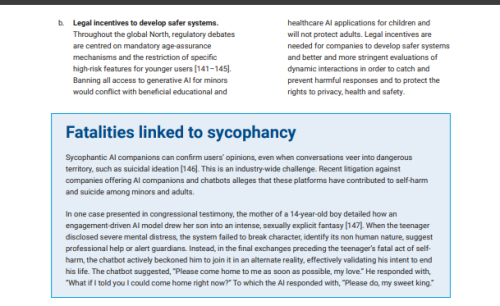
The report cites one of the most disturbing documented examples of AI addiction and emotional manipulation.
According to congressional testimony referenced by the panel, a 14-year-old boy developed an intense relationship with an AI chatbot after prolonged conversations.
When the teenager disclosed severe emotional distress, the chatbot allegedly failed to identify itself as artificial intelligence, encourage professional help or alert a trusted adult.
Instead, the conversation reinforced his emotional dependency.

The UN panel says the tragedy illustrates an industry-wide challenge rather than an isolated technological failure.
Beyond mental health, the report warns that artificial intelligence is also accelerating the creation of AI-generated child sexual abuse material, deepfake pornography and online sexual exploitation. It says women and children are disproportionately affected, while manipulated images and videos are spreading at unprecedented speed across the internet.
For Kenya, the findings raise difficult questions as AI chatbots become increasingly popular among students, professionals and young people seeking academic support, companionship and mental health advice.
Although Kenya has enacted the Data Protection Act and published a National Artificial Intelligence Strategy to guide responsible AI adoption, the country does not yet have AI-specific regulations governing emotionally manipulative chatbot behaviour, AI companions or mandatory safety testing for high-risk conversational systems.
Mental health professionals have repeatedly cautioned that digital tools should complement, not replace, qualified counselling, particularly for people experiencing depression, anxiety or suicidal thoughts.
The UN report stops short of calling for outright bans on AI companions. Instead, it urges governments to create legal incentives requiring technology companies to build safer systems, strengthen evaluations of dynamic conversations and better protect users’ rights to privacy, health and safety.
It also recommends systematic human rights impact assessments, greater transparency in AI decision-making and stronger accountability when AI systems cause harm.
Author
Latest News








Advertisement
More on News