Advertisement
Revealed: How fake AI content could destroy public trust ahead of Kenya’s 2027 polls
Saturday 04th July, 2026 11:44 PM|

As Kenya prepares for the 2027 General Election, a landmark United Nations scientific report is warning that artificial intelligence could fundamentally change how voters consume information, making it increasingly difficult to distinguish truth from fiction.
The Preliminary Report of the Independent International Scientific Panel on Artificial Intelligence, released in July 2026, warns that AI-generated misinformation, deepfake videos and sophisticated digital influence campaigns threaten to undermine public trust, democratic institutions and election integrity around the world.
Unlike previous misinformation campaigns that relied on human networks, the report says AI now enables fake content to be produced, personalised and distributed at unprecedented speed and scale.
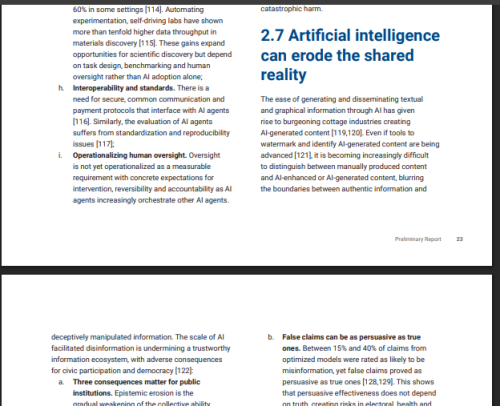
“The ease of generating and disseminating textual and graphical information through AI has given rise to burgeoning cottage industries creating AI-generated content,” the report states.
You Might Also Like


“It is becoming increasingly difficult to distinguish between manually produced content and AI-enhanced or AI-generated content, weakening trust in information and democratic debate.”
The report introduces three emerging concepts that governments, including Kenya’s, may soon have to confront before voters head to the ballot.
The first is epistemic erosion, which it describes as the gradual weakening of society’s collective ability to distinguish truth from falsehood.
The second is the liar’s dividend, where the existence of convincing AI deepfakes allows politicians or public figures to dismiss genuine evidence as fabricated.
The third is synthetic consensus, the creation of thousands or even millions of AI-generated posts, comments and videos that falsely create the impression that large sections of the public support a particular candidate, policy or narrative.
Threat to democracy
According to the report, these developments could fundamentally reshape democratic discourse by manufacturing public opinion rather than reflecting it.
The panel warns that AI-powered influence operations are becoming increasingly sophisticated.

“AI provides a powerful toolkit for actors to conduct personalised, real-time and adaptive persuasion,” the report says. It notes that AI systems can tailor messages to individual users, making misinformation campaigns significantly more effective than traditional political propaganda.
Even more concerning, the report says persuasive AI does not necessarily rely on facts.
It found that between 15 and 40 per cent of claims generated by optimised AI systems were likely to contain misinformation, yet false claims proved just as persuasive as truthful ones.
“Persuasive effectiveness does not depend on truth,” the report reads, indicating the risks for elections, public health and democratic institutions.
For Kenya, where social media has become a dominant source of political information, the findings come at a critical moment.
The 2027 General Election is expected to be Kenya’s most digitally connected election, with political campaigns increasingly relying on TikTok, Facebook, X, WhatsApp and AI-powered content creation tools.

Experts have already warned that generative AI could enable realistic fake speeches, fabricated campaign posters, cloned voices and manipulated videos capable of spreading rapidly before fact-checkers can respond.
Kenya has previously experienced online disinformation during election periods, but the UN panel suggests AI could make future campaigns more difficult to detect and contain because fake content can now be generated instantly, personalised for different audiences and continuously adapted in response to user behaviour.
The report also warns that AI-mediated information systems threaten the financial sustainability of journalism, while deepfake campaigns have already influenced elections in some countries.
“Synthetic media are also eroding the ability of the public and institutions to distinguish authentic from generated content,” it says.
The findings are likely to intensify debate in Kenya over whether existing safeguards are sufficient. Institutions such as the Independent Electoral and Boundaries Commission (IEBC), the Communications Authority of Kenya (CAK), fact-checking organisations, cyber-security researchers and digital rights advocates are expected to play a central role in identifying AI-generated election content, educating voters and protecting the integrity of the electoral process.
Rather than relying solely on content moderation, the UN panel recommends broader strategies that address the economic, technical and behavioural systems that allow AI misinformation to spread so effectively.
It notes that only a minority of countries have developed comprehensive national strategies to combat AI-driven disinformation and online persuasion.
Author
Latest News




Advertisement
More on Inside Politics