Advertisement
FAO Food Price Index: Why lower global food prices may not cut Kenya’s grocery bills
Sunday 05th July, 2026 12:13 AM|

Global food prices rise and fall every month, but many consumers in Kenya often wonder why supermarket prices do not always move in the same direction. The answer lies in a combination of international commodity markets, exchange rates, shipping costs, taxes and local supply conditions.
The latest Food Price Index released on Friday, July 3, 2026, by the Food and Agriculture Organisation (FAO) shows that the benchmark for global food commodity prices declined for the second consecutive month in June. The index, which tracks monthly changes in international prices of a basket of globally traded food commodities, averaged 130.3 points, slightly lower than the 130.8 points recorded in May.
Although the decline suggests easing pressure in international food markets, the index remained 2.2 per cent higher than a year earlier, highlighting that food prices are still above last year’s levels despite recent improvements.
For Kenya, where wheat, edible oils and sugar are among key imported food commodities, changes in global prices can influence the country’s import bill and eventually affect the cost of producing bread, cooking oil, processed foods and animal feeds.
You Might Also Like



However, consumers may not see immediate reductions in retail prices because importers and manufacturers must also contend with exchange rate movements, freight charges, taxes and domestic operating costs.
The June decline was largely driven by cereals. The FAO Cereal Price Index fell 3.5 per cent from May as international maize and wheat prices weakened.
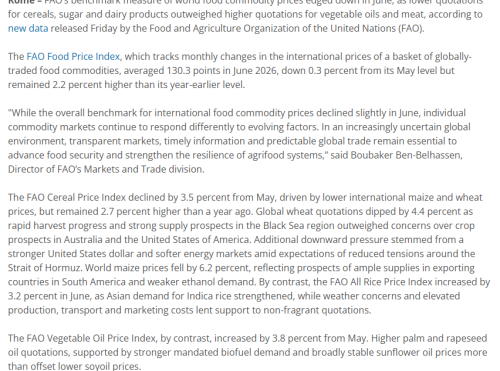
Global wheat prices dropped 4.4 per cent due to improved harvest prospects and abundant supplies from the Black Sea region. Maize prices declined by 6.2 per cent amid expectations of ample export supplies from South America and weaker demand from the ethanol industry.
Lower wheat prices could eventually reduce input costs for flour millers and bakeries that rely on imported grain, while cheaper maize may ease costs for livestock feed manufacturers.
However, any savings reaching Kenyan consumers will depend on import contracts, transport costs and the strength of the Kenyan shilling against major trading currencies.
Not all commodities followed the same trend. International rice prices rose 3.2 per cent as stronger demand across Asia and weather concerns tightened supplies. This means countries that rely heavily on imported rice could continue facing upward price pressure despite the broader decline in global food prices.
Inflation crisis
The Sugar Price Index recorded the largest monthly decline, falling 5.7 per cent after lower ethanol prices in Brazil and the depreciation of the Brazilian real made exports more competitive. Even so, concerns over the possible impact of El Niño on sugar production in India and Thailand prevented steeper declines.
Dairy prices also eased by 1.5 per cent as export supplies continued to exceed global demand.

In contrast, vegetable oil prices increased by 3.8 per cent, supported by stronger demand for palm and rapeseed oils linked to biofuel policies. This explains why cooking oil prices can remain elevated even when the overall global food price index is falling.
Meat prices also climbed 0.5 per cent to a record high, driven mainly by higher poultry prices.
“While the overall benchmark for international food commodity prices declined slightly in June, individual commodity markets continue to respond differently to evolving factors,” said Boubaker Ben-Belhassen, Director of FAO’s Markets and Trade Division.
“In an increasingly uncertain global environment, transparent markets, timely information and predictable global trade remain essential to advance food security and strengthen the resilience of agrifood systems.”
For businesses, including grain importers, millers, food manufacturers and retailers, global commodity prices remain an important indicator of future production costs and pricing decisions.
Even so, for consumers, the cost of living depends on more than international prices alone. Local harvests, weather conditions, fuel costs, taxation and currency movements all determine whether lower global food prices eventually translate into cheaper food on supermarket shelves.
Author
Latest News







Advertisement
More on Business