Advertisement
CBK and Rwanda Central Bank sign deal to ease cross-border payments
Thursday 12th March, 2026 09:02 AM|

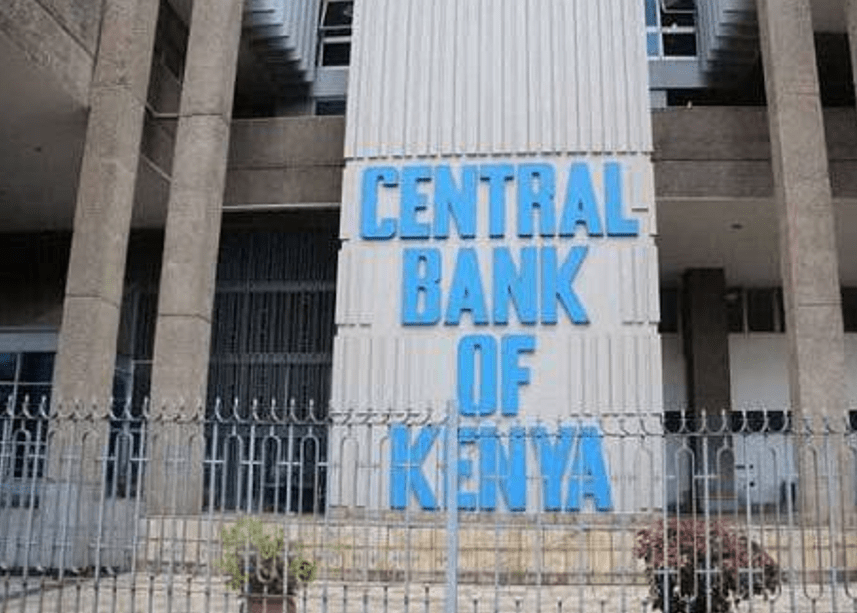
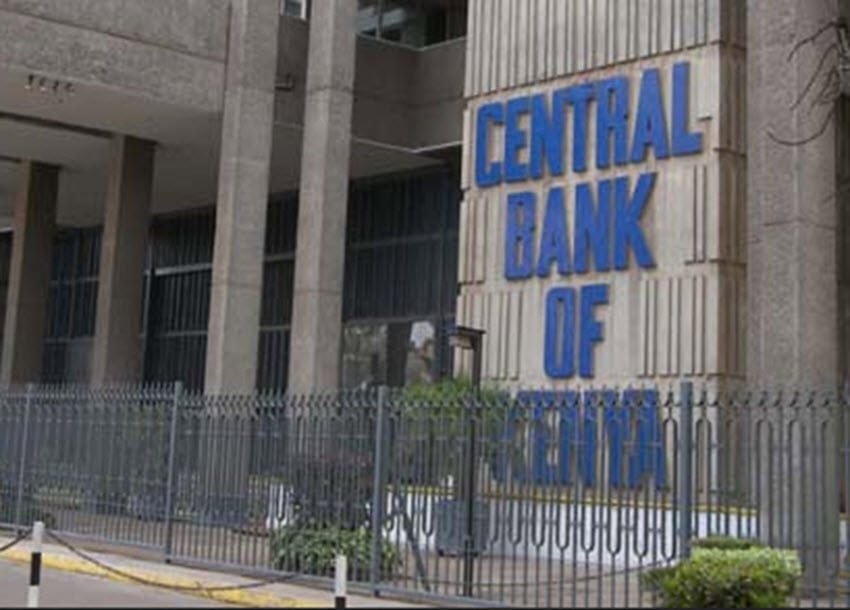
The Central Bank of Kenya (CBK) and the National Bank of Rwanda (NBR) have signed a Memorandum of Understanding (MoU) aimed at simplifying how payment service providers operate across the two countries.
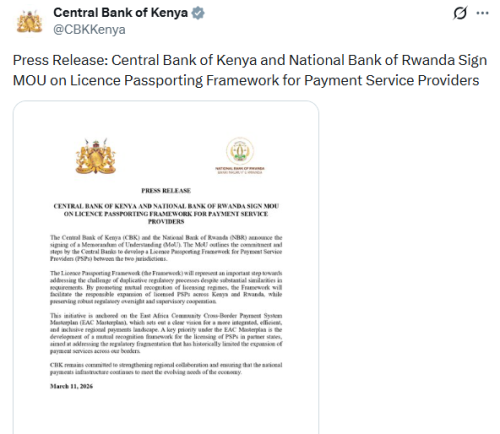
In a statement released in March 11, 2026, CBK said the agreement commits both regulators to develop a Licence Passporting Framework for Payment Service Providers (PSPs) between Kenya and Rwanda.
The proposed framework will allow licensed payment companies in one country to expand into the other without going through an entirely new licensing process. Regulators say the move will reduce duplicated regulatory requirements that have slowed the growth of financial services across borders.
“The Central Bank of Kenya (CBK) and the National Bank of Rwanda (NBR) announce the signing of a Memorandum of Understanding (MoU). The MoU outlines the commitment of the two Central Banks to develop a Licence Passporting Framework for Payment Service Providers (PSPs) between the two jurisdictions,” the statement said.
You Might Also Like

Under the planned system, payment companies such as fintech firms and mobile money operators will rely on mutual recognition of licences. This allows a firm licensed in Kenya to expand into Rwanda more easily, while companies licensed in Rwanda can enter the Kenyan market with reduced regulatory hurdles, though they remain under supervision from both regulators.
According to CBK, the framework aims to remove regulatory duplication that forces firms to repeat nearly identical licensing procedures in different countries despite meeting similar standards.
“The Licence Passporting Framework will represent an important step towards addressing the challenge of duplicative regulatory processes despite substantial similarities in requirements,” the regulator said.
Officials say the arrangement will still maintain strict supervision by both regulators. While firms may expand more easily, they will continue to operate under oversight from both central banks.
“By promoting mutual recognition of licensing regimes, the Framework will facilitate the responsible expansion of licensed PSPs across the two jurisdictions, while preserving robust regulatory oversight and supervisory cooperation,” CBK added.
Regional payments integration push
The agreement forms part of a wider regional effort to integrate payment systems across East Africa. Both regulators confirmed that the initiative aligns with the East African Community (EAC) Cross-Border Payment System Masterplan.
The strategy sets out a roadmap for creating a more connected regional payments ecosystem, making it easier for businesses and individuals to send and receive money across borders.
“This initiative is anchored in the East Africa Community Cross-Border Payment System Masterplan, which sets out a clear vision for a more integrated, efficient, and inclusive regional payments landscape,” CBK said.
The Masterplan prioritises the creation of a mutual recognition system for payment service licences across EAC member states. Regulators believe this will help address long-standing regulatory fragmentation that has limited the expansion of payment services across the region.
Kenya and Rwanda already have strong financial technology sectors and growing digital payment adoption. By reducing regulatory barriers, policymakers expect the agreement to encourage fintech innovation and cross-border investment.
The framework could also benefit businesses and consumers by enabling faster digital transactions, smoother remittances, and wider access to financial services across the two markets.
CBK said the move reflects its broader commitment to regional financial cooperation and the development of efficient payment infrastructure.
“CBK is committed to strengthening regional collaboration and ensuring that the national payments infrastructure continues to meet the evolving needs of the economy,” the bank said.
Once implemented, the licence passporting framework could become a model for wider financial integration within the East African region.
Author
Kenneth Mwenda
Kenneth Mwenda is a business, sports, and politics digital writer with over seven years of experience in journalism, covering breaking news, feature stories, and in-depth analysis across a range of beats.
For inquiries, he can be reached at [email protected]
View all posts by Kenneth MwendaLatest News







Advertisement
More on Business