Advertisement
MPs debate tea pricing report amid Rift Valley farmer disparities
Thursday 23rd April, 2026 10:50 PM|

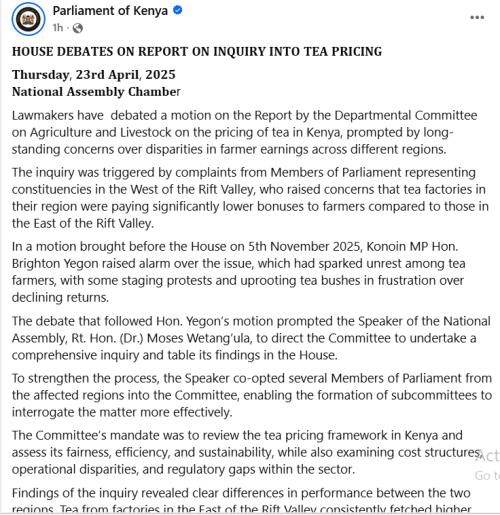
Kenya’s National Assembly on Thursday, April 23, 2026 engaged in a heated debate over the Departmental Committee on Agriculture and Livestock’s report on tea pricing, highlighting deep regional disparities that continue to frustrate farmers, especially in the Rift Valley.
The motion, first raised by Konoin MP Brighton Yegon on November 5, 2025, stemmed from complaints by lawmakers from West of the Rift Valley.
Tea factories in their constituencies have been paying significantly lower bonuses compared to those East of the Rift, triggering farmer protests and even the uprooting of tea bushes in frustration over declining earnings.
Speaker Moses Wetang’ula subsequently directed the Committee to conduct a comprehensive inquiry, co-opting MPs from affected regions to ensure balanced scrutiny.
Findings highlight quality, cost and structural gaps
You Might Also Like
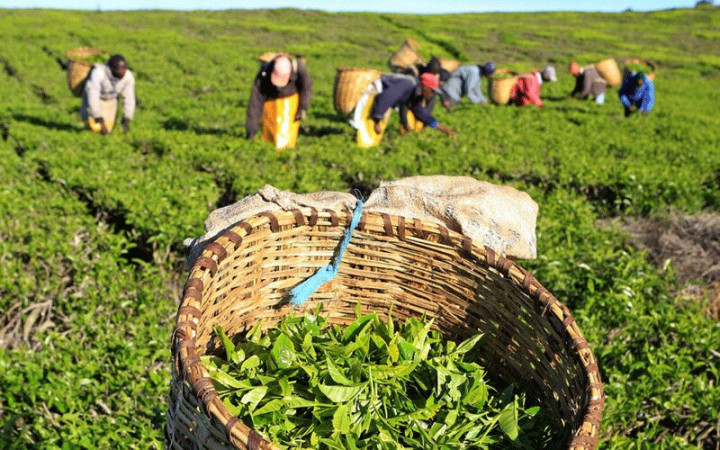

The Committee’s findings, tabled in the House, painted a stark picture of inequality. Tea from Eastern Rift Valley factories consistently fetched higher prices at the Mombasa Tea Auction due to superior quality.
In contrast, Western factories grappled with hawking, mixed cultivars, multiple low-grade processors, and severe operational inefficiencies. Transport delays up to 18 hours for green leaf delivery in the West versus just two hours in the East further degraded quality and reduced farmer payouts.
Higher labour costs from collective bargaining agreements, elevated energy expenses, transport challenges, procurement irregularities, and weak oversight compounded the problem.
The report also flagged broader structural issues: Kenya’s over-reliance on markets like Pakistan and Egypt, minimal value addition, and the lack of a comprehensive tea sector policy.
Moving the motion, Committee Chairperson John Mutunga described the disparities as a “critical issue” deeply affecting farming communities. He defended the Kenya Tea Development Agency (KTDA) model as globally respected but stressed the need to address isolated cases of mismanagement.
“The problem is not with KTDA or the farmers but a compounding issue arising from the disregard of quality standards,” Mutunga said, noting that over half of KTDA factories perform well.
Mixed reactions as lawmakers propose reforms
The debate however, elicited mixed reactions. Endebes MP Robert Pukose blamed leadership failures in factories and called for urgent reforms and greater accountability. Conversely, Bureti MP Hon. Kibet Komingoi disputed quality as the main factor, pointing instead to bias in the pricing structure. He urged the establishment of a second auction centre in the West of the Rift Valley to improve market access and fairness.
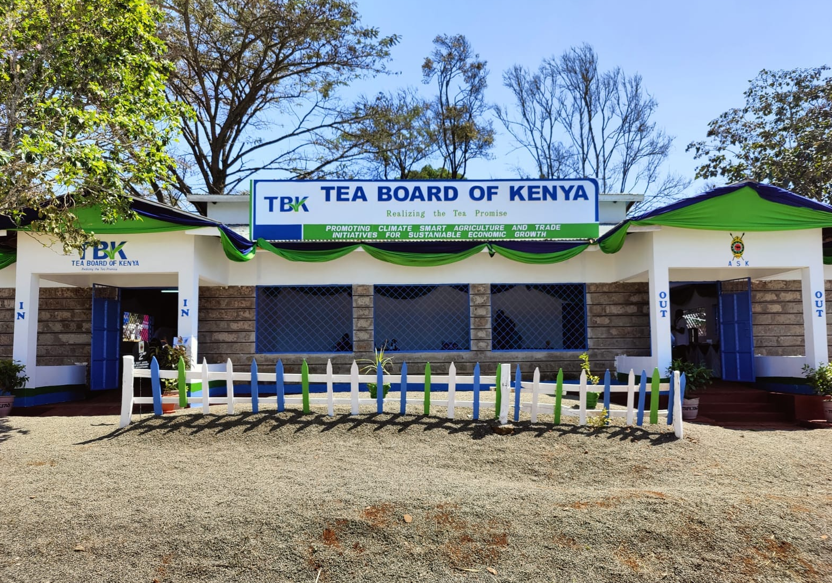
The Committee recommended stronger regulation by the Tea Board of Kenya, factory audits, quality enforcement, market diversification, direct sales promotion, and increased funding for the Tea Research Institute to cut costs and boost efficiency.
Author
Latest News







Advertisement
More on News