Advertisement
Treasury opens applications for National Infrastructure Fund CEO
Tuesday 14th July, 2026 05:09 PM|

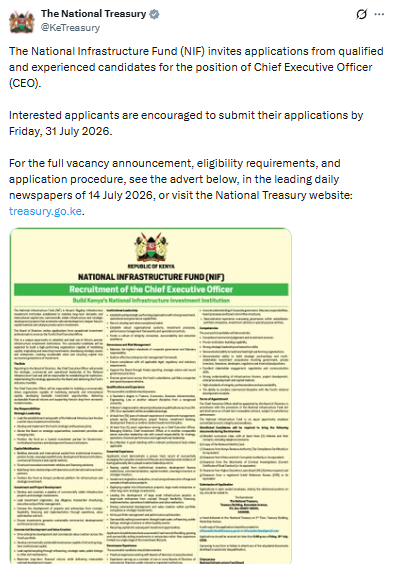
The National Treasury has opened applications for the position of Chief Executive Officer (CEO) of the National Infrastructure Fund (NIF), marking another major milestone in the government’s plan to transform how Kenya finances large infrastructure projects.
The recruitment notice, published by the Treasury on Monday, July 13, 2026, comes days after the appointment of the National Infrastructure Fund Board and follows months of work to operationalise the fund, which is expected to mobilise up to Ksh5 trillion over the next decade.
According to the advert, the successful candidate will serve as the Accounting Officer and principal executive of the Fund, reporting directly to the Board of Directors. The CEO will oversee the day-to-day management of the institution while leading efforts to mobilise capital, finance strategic projects and establish the NIF as one of Africa’s leading infrastructure investment institutions.
Treasury seeks experienced investment leader
The National Infrastructure Fund said it is looking for a highly qualified and experienced professional capable of leading one of Kenya’s most ambitious economic initiatives.
You Might Also Like

“The successful candidate will be expected to build a high-performing organisation capable of mobilising capital, originating and executing investments, developing strategic assets and enterprises, creating sustainable value and recycling capital into successive generations of investment,” the recruitment notice states.
The successful applicant will provide strategic leadership, oversee resource mobilisation, ensure prudent financial management and supervise the implementation of infrastructure projects financed through the fund.
Among the CEO’s responsibilities will be identifying and financing priority national infrastructure projects, building partnerships with government agencies, development partners and private investors, advising the Board, monitoring project performance and representing the Fund both locally and internationally.
The CEO will also be expected to build a high-performance organisation capable of attracting billions of shillings in long-term investment while ensuring strong governance and accountability.
“The Chief Executive Officer will be responsible for building a commercially driven organisation capable of mobilising domestic and international capital, developing bankable investment opportunities, delivering sustainable financial returns and supporting Kenya’s long-term economic transformation.”
Why the National Infrastructure Fund was created
The National Infrastructure Fund was established under the National Infrastructure Fund Act, 2026, which President William Ruto signed into law in March 2026.
The Fund represents a major shift in Kenya’s approach to financing infrastructure.
For decades, many large projects relied heavily on government borrowing and external loans. The NIF introduces a different model by bringing together public resources and private investment to finance commercially viable infrastructure.
Instead of depending mainly on debt, the Fund will mobilise money from:
- Government allocations
- Pension funds
- Sovereign wealth funds
- Private investors
- Development finance institutions
- Privatisation proceeds
- Grants and concessional financing
- Investment returns
The government says this approach will reduce pressure on public debt while ensuring strategic projects continue without delays caused by funding shortages.
President Ruto recently described the new financing model as a turning point for Kenya’s development agenda.
“We now have a formula, under the National Infrastructure Fund, to deliver these projects.”
The President added that Kenya can no longer afford to postpone major infrastructure investments that support economic growth.
Projects expected to benefit
The National Infrastructure Fund is expected to finance some of the country’s largest development projects.
Among those already identified are:
| Project | Expected impact |
|---|---|
| Jomo Kenyatta International Airport modernisation | Expansion of passenger and cargo capacity |
| Nairobi-Namanga Highway | Faster regional transport and trade |
| National road projects | More than 20,000 kilometres of roads over seven years |
| Energy projects | Additional electricity generation capacity |
| Water and irrigation projects | Improved water access and food security |
| Ports and logistics infrastructure | Increased trade efficiency |
President Ruto has also said Kenya requires an additional 10,000 megawatts of electricity to meet growing demand, with the NIF expected to play a significant role in financing that expansion.
NIF leadership structure now taking shape
The recruitment of a CEO follows several key appointments made over the past few months.
In April 2026, President William Ruto appointed members of the National Infrastructure Fund Governing Council.
The council consists of:
| Position | Member |
|---|---|
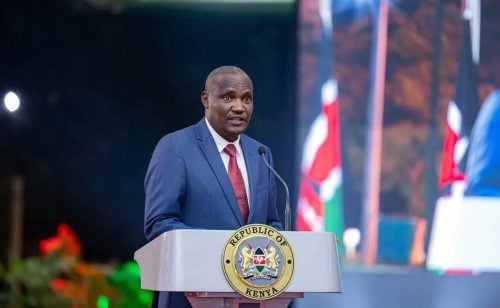
| Chairperson | Treasury CS John Mbadi |
| Ex-officio member | CBK Governor Kamau Thugge |
| Ex-officio member | Attorney General Dorcas Agik Oduor |
| Member | Benedict Okey Oramah |
| Member | Faith Boinnet |
| Member | Paul Russo |
| Member | Richard Etemesi |
On July 8, 2026, Treasury Cabinet Secretary John Mbadi appointed six additional members to the National Infrastructure Fund Board.
The new board members are:
| Board member | Current background |
|---|---|
| James Mworia Mwirigi | CEO, Centum Investment Company |
| Fahima Ali Ahmed Zein | Investment professional |
| Christopher Kibui Maranga | Former Acumen East Africa Regional Director |
| Latoya Ouna | Corporate executive |
| Lawrence Kibet | Director General, Public Investments and Portfolio Management, National Treasury |
| Mohammed Abdirahman Hassan | Investment and finance professional |
The appointments provide the governance framework required before the Fund becomes fully operational.
Qualifications required for the CEO
The Treasury has set a high threshold for applicants.
Candidates must possess:
- A Bachelor’s degree in Finance, Economics, Engineering, Law, Business Administration or another relevant discipline.
- A Master’s degree in a relevant field.
- Professional qualifications such as CPA, CFA or CA will be an added advantage.
- At least 10 years’ relevant experience, including five years in a senior leadership position.
Applicants should also demonstrate integrity, financial management skills, strategic thinking, stakeholder management experience and the ability to lead complex organisations.
The recruitment notice emphasises the need for a leader capable of attracting both domestic and international investment while ensuring value for money in every project financed through the Fund.
How much money has the NIF raised?
Even before becoming fully operational, the National Infrastructure Fund has already secured significant capital.
President Ruto recently announced that the Fund has raised Ksh350 billion within its first three months.
According to the President, the money includes:
| Source | Amount |
|---|---|
| Partial sale of government Safaricom shares | Ksh244 billion |
| Sale of a 65 per cent stake in Kenya Pipeline Company | Ksh106 billion |
| Total raised | Ksh350 billion |
The government has said these resources will finance major infrastructure projects without increasing reliance on expensive borrowing.
Earlier this month, Treasury also dismissed claims circulating online that the Fund would use SACCO savings, insisting that ordinary Kenyans’ deposits would not be accessed.
Application deadline
Applications must be submitted to The Secretariat, National Treasury, either in a sealed envelope delivered to the Treasury Building on Harambee Avenue or by email to [email protected] or [email protected], by 5.00 p.m. on Friday, July 31, 2026.
Shortlisted candidates will be required to present a detailed CV, a national ID and clearance certificates from KRA, EACC, DCI, HELB (where applicable) and a registered Credit Reference Bureau (CRB). The advert warns that canvassing or failure to submit the required documents will lead to automatic disqualification.
Once appointed, the CEO will lead the National Infrastructure Fund’s operations, drive investment into priority infrastructure projects and help position the Fund as a key vehicle for financing Kenya’s long-term economic development.
Author
Kenneth Mwenda
Kenneth Mwenda is a business, sports, and politics digital writer with over seven years of experience in journalism, covering breaking news, feature stories, and in-depth analysis across a range of beats.
For inquiries, he can be reached at [email protected]
View all posts by Kenneth MwendaLatest News





Advertisement
More on Business