Advertisement
Vodacom completes acquisition of extra 20% stake in Safaricom
Tuesday 30th June, 2026 06:10 PM|

Vodacom Group Limited has completed its acquisition of an additional 20 per cent effective stake in Safaricom PLC, lifting its total ownership to about 55 per cent. The deal gives Vodacom majority control of Kenya’s largest telecom and mobile money operator after months of legal, regulatory and parliamentary scrutiny.
The transaction closed on Tuesday, June 30, 2026, following the lifting of court restrictions by the Court of Appeal in Kenya on June 26, 2026, and the completion of all remaining conditions. Vodacom said the acquisition allows it to consolidate Safaricom fully in its financial statements under IFRS rules.
The deal, worth $2.1 billion (around Ksh272 billion), was first announced in December 2025. It forms part of a broader restructuring of Safaricom’s ownership, involving the Government of Kenya and Vodafone Group Plc.
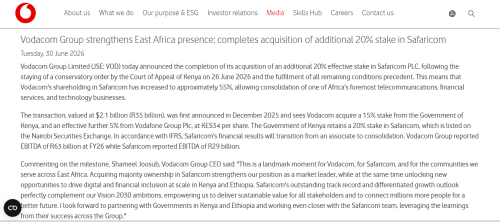
“Vodacom Group Limited (JSE: VOD) today announced the completion of its acquisition of an additional 20% effective stake in Safaricom PLC, following the staying of a conservatory order by the Court of Appeal of Kenya on 26 June 2026 and the fulfilment of all remaining conditions precedent. This means that Vodacom’s shareholding in Safaricom has increased to approximately 55%, allowing consolidation of one of Africa’s foremost telecommunications, financial services, and technology businesses,” the telecommunications press statement read in part.
Court Battles, approvals and ownership restructuring
You Might Also Like
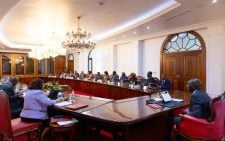


The Safaricom stake sale moved through a complex legal and regulatory process before completion.
Initially, the Kenyan government’s plan to sell a 15 per cent stake in Safaricom attracted court challenges. Petitioners argued that Safaricom was a strategic national asset and that the sale required stricter constitutional scrutiny. They also questioned valuation methods, saying the share price used in the transaction undervalued the company.
The High Court first issued conservatory orders stopping the transaction, citing unresolved constitutional issues such as public participation, data governance and transparency in valuation. This temporarily froze implementation of the deal.
However, the Court of Appeal later overturned the suspension on June 26, 2026. The appellate judges ruled that the government had met the legal threshold for a stay and that public interest supported allowing the transaction to proceed while the case continued.
The ruling cleared the way for completion of the transaction. It also confirmed that the government could proceed with the partial divestiture while retaining oversight through its remaining stake.
The ownership structure was also refined during the process. The Government of Kenya retains a 20 per cent stake in Safaricom, while Vodacom has increased its effective holding to about 55 per cent. The remaining shares are held by public investors on the Nairobi Securities Exchange.
Structure of the deal and financial terms
The transaction was structured in two main parts.
Vodacom acquired a 15 per cent stake directly from the Government of Kenya and an additional effective 5 per cent from Vodafone Group Plc (Ksh204.3 billion for the 15 per cent government stake and Ksh68 billion for the effective 5 per cent from Vodafone).
. The purchase price was set at Ksh34 per share, which included a premium over earlier trading averages.
The Treasury described the pricing as based on average market performance over several months, with an added premium to reflect strategic value. Earlier government disclosures indicated the sale was intended to raise funds for infrastructure development while maintaining national influence through a reduced but significant shareholding.
Reports linked to the transaction also show that part of the deal included dividend monetisation arrangements tied to the government’s remaining stake, allowing the state to access future value upfront while retaining ownership.
Vodacom confirmed that Safaricom will now be treated as a subsidiary in its accounts, meaning its full revenue, assets and liabilities will be consolidated into Vodacom Group results.
“In accordance with IFRS, Safaricom’s financial results will transition from an associate to consolidation.”
For FY26, Vodacom reported EBITDA of Ksh498 billion, while Safaricom recorded EBITDA of Ksh229 billion. This combined scale strengthens Vodacom’s position across African telecom markets.
Leadership views and strategic direction
Vodacom Group CEO Shameel Joosub described the transaction as a major milestone for the company’s long-term African strategy.
“This is a landmark moment for Vodacom, for Safaricom, and for the communities we serve across East Africa,” he said. “Acquiring majority ownership in Safaricom strengthens our position as a market leader, while at the same time unlocking new opportunities to drive digital and financial inclusion at scale in Kenya and Ethiopia.”
He added that Safaricom’s performance and growth outlook align with Vodacom’s Vision 2030 strategy, which focuses on expanding digital services and financial inclusion across African markets.
Safaricom remains one of the region’s most influential technology companies. It operates Kenya’s leading mobile money platform M-Pesa, which plays a central role in financial inclusion. Around 44 per cent of its Kenyan revenue comes from fintech services.
The company has also expanded into Ethiopia, where it has built a customer base of about 14 million users. Its business now includes cloud services, Internet of Things (IoT), and enterprise solutions, positioning it as a diversified digital services provider.
Kenya’s National Treasury defended the sale as part of a broader strategy to unlock value from state assets and fund infrastructure development.
Cabinet Secretary Hon. FCPA John Mbadi said the government’s original investment in a mobile licence had grown into a major national asset over 25 years.
“Twenty-five years ago, the Government of Kenya made a founding investment in a mobile telephone licence,” he said. “That investment has grown into Safaricom — a company that has transformed financial inclusion across Africa, connected more than fifty million Kenyans, and contributed over one-and-a-half trillion shillings to the Exchequer.”
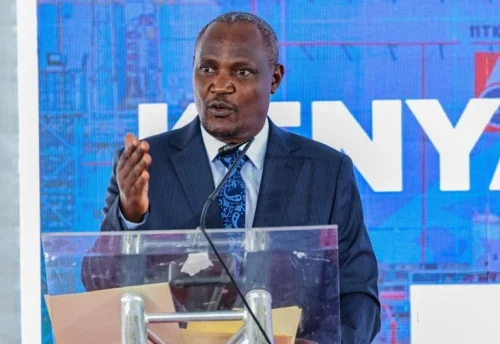
He added that proceeds from the sale will support key national infrastructure projects, including roads, energy systems, water networks and airports.
According to Treasury-linked reports, the transaction allows the government to unlock immediate fiscal space while still retaining influence through its remaining 20 per cent stake in Safaricom.
Earlier parliamentary and regulatory approvals formed part of the process, alongside oversight from capital markets and regional competition authorities.
Author
Kenneth Mwenda
Kenneth Mwenda is a business, sports, and politics digital writer with over seven years of experience in journalism, covering breaking news, feature stories, and in-depth analysis across a range of beats.
For inquiries, he can be reached at [email protected]
View all posts by Kenneth MwendaLatest News


Advertisement
More on Business