Advertisement
Nairobi building approvals drop 9.3% as land market slows
Sunday 03rd May, 2026 09:16 PM|

Land prices in Nairobi’s suburbs and satellite towns rose at a slower pace in the first quarter of 2026, as tighter economic conditions and uncertainty over planning approvals weighed on demand, according to the latest HassConsult Land Price Index released in late April 2026.
In the suburbs, land prices increased by just 0.8 per cent in the quarter, bringing the annual growth to 5.0 per cent. The average price per acre stood at Ksh 228.8 million. This marks a slowdown compared to the 1.3 per cent growth recorded in the previous quarter.
HassConsult noted that developers have become more cautious due to unclear building approval processes at Nairobi County offices, which have affected new project launches.
“Demand for land parcels for new suburban projects eased during the period, as developers continued to face uncertainty around planning approvals at the county level, with some projects further delayed by resistance from resident associations,” said Sakina Hassanali, Co-CEO and Creative Director at HassConsult.
You Might Also Like



Several high-end suburbs recorded price declines. Muthangari led the drop at -2.8 per cent, followed by Loresho at -2.0 per cent and Kitisuru at -1.5 per cent. On the other hand, Nyari and Langata posted gains of 3.1 per cent and 2.4 per cent, respectively, making them the strongest performers in the suburbs during the quarter.
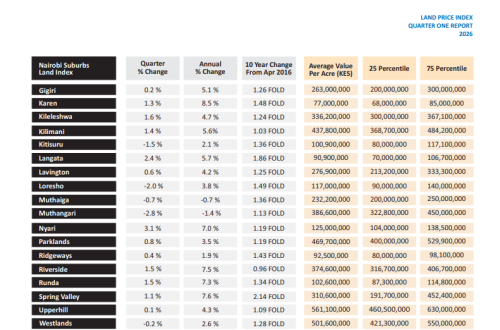
Most other suburbs recorded modest growth between 0.1 per cent and 1.6 per cent, showing a generally flat market across much of Nairobi’s prime residential zones.
Despite the slowdown in growth, land values remain high. The report shows that even the small quarterly increase translated into a significant rise in value due to the high base prices in the suburbs.
Satellite towns’ slowdown deepens
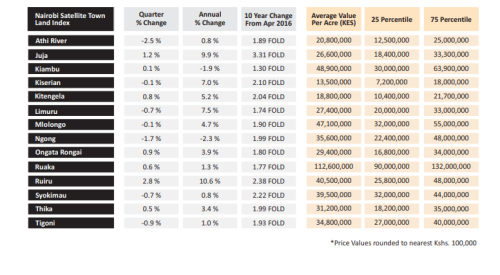
In the satellite towns, land prices grew by only 0.5 per cent in the quarter, the slowest rate in five years. Annual growth stood at 4.29 per cent, with the average price per acre rising to Ksh 33 million.
The performance of satellite towns was uneven. Seven of the 14 towns recorded price declines. Athi River fell by -2.5 per cent, Ngong by -1.7 per cent, and Syokimau by -0.7 per cent. These areas had previously been strong growth centres due to infrastructure expansion and rising demand from middle-income buyers.
Ruiru stood out as the strongest performer among satellite towns, growing by 2.8 per cent in the quarter and 10.6 per cent over the year. Juja also posted positive growth, supported by continued activity along the Thika Highway corridor. Ongata Rongai and Kitengela also saw mild increases.
Hassanali said the market is now adjusting after a long period of rapid expansion.
“The infrastructure-led uplift across many of Nairobi’s satellite towns that underpinned earlier growth is now largely priced into land values. Against a tighter economic backdrop, this has reduced affordability for self-build buyers, narrowing the addressable market,” she said.
The report also highlighted a slowdown in new development activity. The value of building approvals in Nairobi County dropped by 9.3 per cent in the 12 months to December 2025. This has reduced the pipeline of new projects entering the market.
Investors are also becoming more cautious. The report notes a rise in allocations to safer assets such as unit trusts and government securities, suggesting a wait-and-see approach among buyers who would normally invest in land.
The satellite towns, which saw a strong price rally over the past five years, are now stabilising. Over that period, average prices rose by 50 per cent, but the current market shows signs of cooling as affordability pressures set in.
Overall, the land market in Nairobi is entering a slower phase of growth. Suburbs remain stable but cautious, while satellite towns are adjusting after years of rapid expansion. Much of the direction in the coming quarters will depend on economic conditions and clarity in planning approvals, which continue to influence investor confidence.
Author
Kenneth Mwenda
Kenneth Mwenda is a business, sports, and politics digital writer with over seven years of experience in journalism, covering breaking news, feature stories, and in-depth analysis across a range of beats.
For inquiries, he can be reached at [email protected]
View all posts by Kenneth MwendaLatest News








Advertisement
More on Business