Advertisement
KRA struggles to meet domestic revenue target despite collecting Ksh1.85 trillion
Sunday 12th July, 2026 09:31 AM|

Kenya’s domestic taxes remained the backbone of government financing in the 2025/26 financial year, contributing nearly two-thirds of the Kenya Revenue Authority’s (KRA) record Ksh2.84 trillion revenue collection.
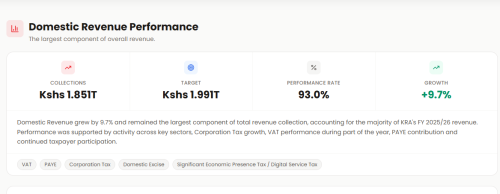
While the Ksh1.851 trillion raised from domestic sources marked a 9.7 per cent increase from the previous year, the figures also reveal a more complex picture of an economy that is growing, but not fast enough to meet the government’s rising revenue ambitions.
In a report released on Friday, July 10, 2026, by the Kenya Revenue Authority the performance highlights two competing realities. Businesses continued paying more corporation tax, formal employment sustained PAYE collections, and consumer spending supported Value Added Tax (VAT). Yet KRA still fell short of its Ksh1.991 trillion domestic revenue target, achieving only 93 per cent of its goal.
Why domestic revenue matters most
Unlike customs revenue, which depends largely on imports, domestic taxes are generated from economic activity within Kenya. Corporation Tax reflects business profitability, PAYE mirrors trends in formal employment, while VAT provides an indication of household consumption.
You Might Also Like



For economists and policymakers, these taxes are the clearest measure of the health of the local economy because they reveal whether companies are making profits, employers are creating jobs and consumers are spending.
KRA attributed the growth to stronger Corporation Tax collections, improved PAYE performance, VAT growth during part of the financial year and continued taxpayer participation across key sectors.
The figures suggest that despite a high cost of living and tighter tax measures introduced in recent years, Kenya’s formal economy remained resilient enough to generate higher revenues than the previous financial year.
Growth but below expectations
However, the missed target tells a different story.
Although domestic revenue expanded by almost 10 per cent, the approximately Ksh140 billion shortfall indicates that economic activity did not grow at the pace projected by the Treasury when revenue targets were set.
The gap also reflects the challenge facing KRA as it seeks to increase tax collections without placing excessive pressure on businesses and households already grappling with rising operating costs, inflationary pressures and slower consumer demand.
For the government, the figures reinforce that raising taxes alone does not automatically translate into higher revenue. Sustainable revenue growth ultimately depends on expanding the economy, increasing business profitability and widening the tax base.
Customs offered the cushion
The domestic revenue performance comes after KRA announced a record Ksh2.84 trillion in total revenue for the 2025/26 financial year, representing 10.1 per cent growth over the previous year.
Much of the overall success was supported by the Customs Department, which exceeded its annual target after collecting Ksh988.78 billion, driven by strong oil revenue and resilient non-oil imports.
While customs helped push overall collections to a historic high, domestic revenue remains the more important long-term indicator. A country cannot rely indefinitely on import taxes to finance its development agenda. Instead, sustainable public finances depend on a growing domestic economy where businesses expand, employment rises and consumer spending remains strong.
As Treasury prepares for another ambitious revenue drive in the 2026/27 financial year, the latest figures suggest KRA’s biggest challenge will not simply be collecting more taxes, but supporting an economic environment capable of generating them.
Author
Latest News







Advertisement
More on Business