Advertisement
Kenya is becoming a goon society: Reuben Kigame sounds alarm over rising violence
Tuesday 14th July, 2026 07:12 AM|

Gospel musician, activist and former presidential aspirant Reuben Kigame has warned that Kenya is sliding into what he described as a “goon society”, saying the country faces a deeper crisis than economic hardship as political violence and moral decline become increasingly normalised.
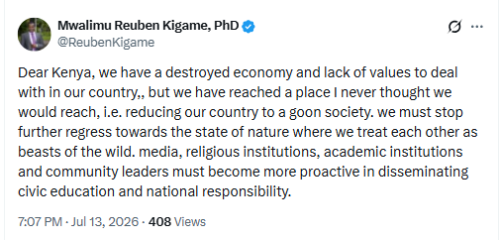
In a statement shared on social media on Monday, July 13, 2026, Kigame lamented what he termed the erosion of national values, urging religious leaders, the media, educational institutions and community leaders to step up civic education efforts before the country descends further into lawlessness.
“Dear Kenya, we have a destroyed economy and lack of values to deal with in our country, but we have reached a place I never thought we would reach, that is reducing our country to a goon society,” Kigame said.
“We must stop further regress towards the state of nature where we treat each other as beasts of the wild.”
Calls for national action
You Might Also Like



Kigame argued that reversing the trend would require more than police action, saying institutions that shape public opinion have a responsibility to rebuild civic responsibility and national cohesion.
He specifically challenged the media, churches, schools, universities and community leaders to become more proactive in promoting patriotism, peaceful coexistence and responsible citizenship.
“Media, religious institutions, academic institutions and community leaders must become more proactive in disseminating civic education and national responsibility,” he added.
His remarks come at a time when concerns over politically instigated violence have intensified following a series of violent incidents linked to public protests, political rallies and by-election campaigns.
Growing concern over ‘goonism’
Kigame’s warning echoes concerns that human rights organisations and governance experts have increasingly raised over the resurgence of politically sponsored gangs, commonly referred to as goons.
Rights groups have warned that politicians are increasingly relying on hired gangs to intimidate rivals, disrupt protests and silence dissent as the country moves closer to the 2027 General Election.
The International Commission of Jurists-Kenya (ICJ Kenya) recently described the proliferation of such gangs as a recurring feature of periods of heightened political competition, while the Kenya Human Rights Commission (KHRC) has argued that the practice amounts to “informal repression”, where violence is allegedly outsourced to non-state actors.
According to rights advocates, the growing use of criminal gangs threatens democratic freedoms by intimidating political opponents and discouraging citizens from participating freely in public affairs.
Violence dominates political landscape
Kigame’s statement also comes amid heightened political tensions following recent protests and election-related clashes across the country.
The issue has again come into sharp focus after violence was reported during campaigns for the Ol Kalou parliamentary by-election, prompting the Independent Electoral and Boundaries Commission (IEBC) to warn of voter bribery, intimidation, and destruction of property, and to warn of the possibility of postponing the poll if the situation deteriorated further.
The Kenya National Commission on Human Rights (KNCHR) similarly condemned reports of killings, organised attacks, gunshots, unlawful night campaigns and voter intimidation during the campaigns, calling for the arrest and prosecution of those responsible.
In Kisumu, authorities have also launched an intensified crackdown on organised criminal gangs following a deadly confrontation in the Milimani area that claimed two lives, with the County Security Committee warning that both perpetrators and those alleged to finance political violence would face the full force of the law.

Echoes of Gen Z protests
The debate over political violence has gained renewed momentum since the youth-led anti-government demonstrations that began in 2024 and continued into subsequent protests, during which allegations emerged that hired gangs were being deployed to infiltrate demonstrations, attack protesters and disrupt civic activities. Human rights organisations have repeatedly called for accountability, arguing that the trend undermines constitutional rights to peaceful assembly and political participation.
The combination of economic hardship, unemployment among young people and intensifying political competition has created fertile ground for the recruitment of vulnerable youth into criminal networks, with some reports suggesting gangs are hired for relatively small sums of money to carry out acts of intimidation or violence.
Author
Mustafa Juma
View all posts by Mustafa JumaLatest News





Advertisement
More on News