Advertisement
Motorists Association rejects EPRA’s reduction of diesel price by Ksh10.06
Tuesday 19th May, 2026 06:15 AM|

The Motorists Association of Kenya has rejected the latest fuel price adjustment announced by the Energy and Petroleum Regulatory Authority (EPRA).
This is despite the regulator reducing the price of diesel by Ksh10.06 per litre.
In a brief but strongly worded statement issued via social media shortly after the announcement that was made on Monday, May 18, 2026, at night, the association said the move is not welcome.
“Unfortunately, this is also rejected,” the association captioned a screengrab of EPRA’s announcement.
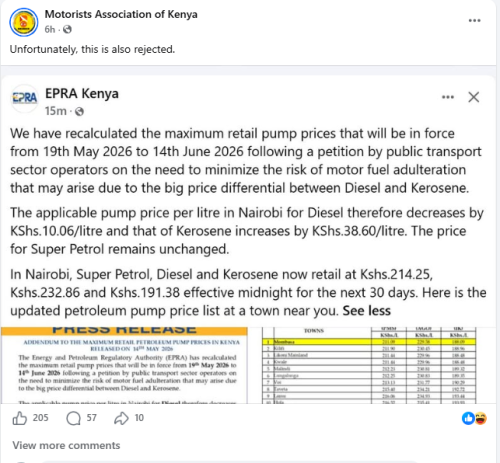
EPRA announces diesel reduction
You Might Also Like

EPRA announced the revised fuel prices through a special addendum issued on the night of May 18, 2026, following mounting pressure from public transport operators and motorists over soaring fuel costs.
Under the revised prices, diesel was reduced by Ksh10.06 per litre, while the price of super petrol remained unchanged. However, the price of kerosene went up by Ksh38.
The new prices took effect at midnight on May 19, 2026, and are expected to remain in force until June 14, 2026.
In Nairobi, Super Petrol will retail at Ksh214.25 per litre, diesel at Ksh232.86 per litre, and kerosene at Ksh191.38 per litre.
Concerns over fuel adulteration
EPRA said the decision to lower diesel prices was partly informed by concerns raised by transport operators over the widening price gap between diesel and kerosene.
According to the regulator, the large difference in pricing had increased the risk of fuel adulteration, where some traders illegally mix fuel products to maximise profits.
“We have recalculated the maximum petroleum prices to be in force from 19th May 2026 to 14th June 2026, following a petition by public transport sector operators on the need to minimise the risk of motor fuel adulteration that may arise due to Diesel & Kerosene price differences,” EPRA’s statement read in part.
“The adjustment follows a petition by public transport sector operators on the need to minimise the risk of motor fuel adulteration.”
Motorists remain dissatisfied
Despite the reduction, the Motorists Association of Kenya maintained that the changes were insufficient and failed to address the broader fuel-pricing crisis affecting Kenyans.
The rejection comes amid an ongoing nationwide strike in the transport sector, driven by anger over rising fuel prices and the rising cost of living.
Transport operators, motorists, and activists have continued piling pressure on the government and EPRA, accusing authorities of overtaxing fuel and failing to cushion ordinary citizens from economic hardship.

Fuel prices remain politically sensitive
Fuel prices have become one of the most contentious economic issues in the country, with increases directly affecting transport fares, food prices, electricity costs, and the broader economy.
The latest standoff highlights growing public frustration despite attempts by regulators to stabilise the market through selective price adjustments.
The transport strike and protests linked to fuel costs have already disrupted movement in several parts of the country, with pressure mounting on the government to introduce more comprehensive relief measures.
Author
Mustafa Juma
View all posts by Mustafa JumaLatest News








Advertisement
More on News