Advertisement
IEBC sets date for the start of mass voter registration
Wednesday 04th February, 2026 01:33 PM|

The Independent Electoral and Boundaries Commission (IEBC) has announced that the Mass Voter Registration (MVR) exercise will resume in March 2026 to complement the ongoing Continuous Voter Registration (CVR).
Speaking on Wednesday, February 4, 2026, after a prayer breakfast meeting with the Evangelical Alliance of Kenya (EAK), IEBC Chairperson Erastus Ethekon announced that the mass voter registration exercise will start in March 2026.
“On voter registration, the Chairperson stated that Continuous Voter Registration (CVR) commenced in September 2025 and will be complemented by enhanced Mass Voter Registration (MVR), which is planned to be escalated to the ward level in March 2026. To support this process, the IEBC is implementing pre-registration reforms and system upgrades aimed at improving efficiency, reducing congestion at registration centres, and enhancing the overall voter experience, particularly for young voters and first-time registrants,” IEBC stated.
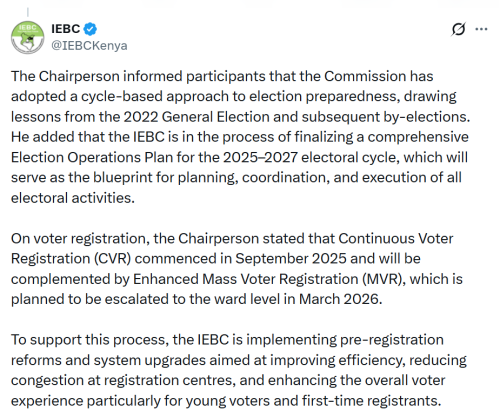
To support this mass voter registration process, the IEBC has said that it is implementing pre-registration reforms and system upgrades aimed at improving efficiency, reducing congestion at registration centres, and enhancing the overall voter experience, particularly for young voters and first-time registrants.
Election preparedness process
You Might Also Like
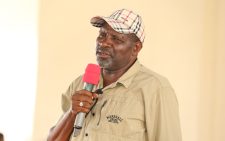
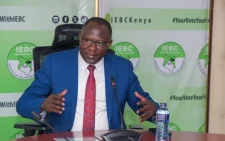
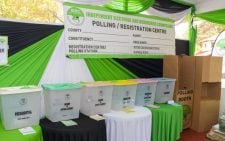
During the breakfast forum, the IEBC Chairperson further noted that the Commission has invested in staff training, digitisation of systems, and continuous stakeholder engagement, recognising that election preparedness is an ongoing and inclusive process despite the resignation of its CEO, Marjan Hussein Marjan.
He emphasised that preparedness does not occur in isolation, noting that the Commission continues to engage faith-based organisations, civil society, political parties, media, security agencies, and development partners.
These partnerships, he said, are critical to voter education, peacebuilding, transparency, and public trust. Despite progress, the Chairperson noted several challenges facing the Commission, including inadequate and delayed funding, delays in electoral legal reforms, which ideally should be finalised at least one year before a General Election to allow effective preparation.
Additionally, the rising threat of misinformation and misuse of digital platforms continues to undermine public trust, peace, and social cohesion.
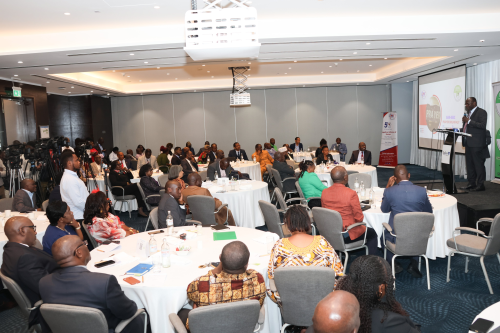
While addressing the gathering, IEBC Chairperson Erastus Edung Ethekon underscored the importance of moral leadership, national unity, and collective responsibility in safeguarding Kenya’s democratic processes. He noted that the engagement with the faith community reflects the Commission’s commitment to inclusivity, dialogue, and trust-building.
The IEBC has also taken note that the Commission has adopted a cycle-based approach to election preparedness, drawing lessons from the 2022 General Election and subsequent by-elections. He added that the IEBC is in the process of finalising a comprehensive Election Operations Plan for the 2025–2027 electoral cycle, which will serve as the blueprint for planning, coordination, and execution of all electoral activities.
Author
Latest News



Advertisement
More on News