Advertisement
Cherargei rejects proposal to scrap hardship allowances
Friday 18th July, 2025 10:25 AM|

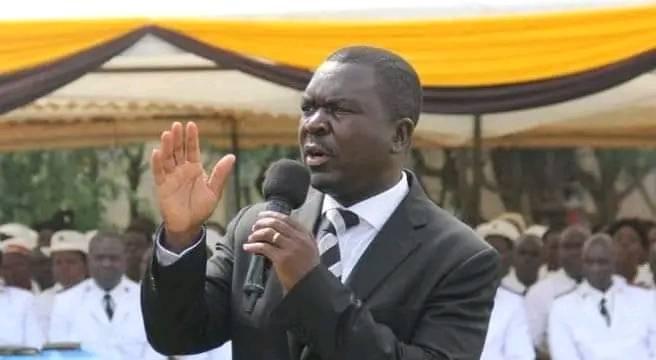
Nandi Senator Samson Cherargei has strongly opposed a proposal to scrap hardship allowances for teachers and civil servants, warning that the move would cripple service delivery in marginalised areas.
The proposal, reportedly originating from the Office of the Prime Cabinet Secretary, seeks to eliminate hardship allowances in a bid to save about Ksh 6 billion. But Cherargei has dismissed the plan as ill-advised and dangerous.
“The intention to try and remove hardship allowances of teachers and other civil servants should be REJECTED. It should remain to motivate workers for service delivery,” he said in a statement on Friday, July 18, 2025.
Hardship allowances are financial incentives meant to attract and retain public servants in remote regions with harsh climatic conditions, poor infrastructure, or limited access to basic services. These areas are officially classified as hardship zones by the government.
You Might Also Like

“What will attract teachers and other civil servants to work in hardship areas if you remove the allowances?” Cherargei posed. He warned that eliminating the stipend would worsen staffing gaps in neglected regions, directly impacting education and access to government services.
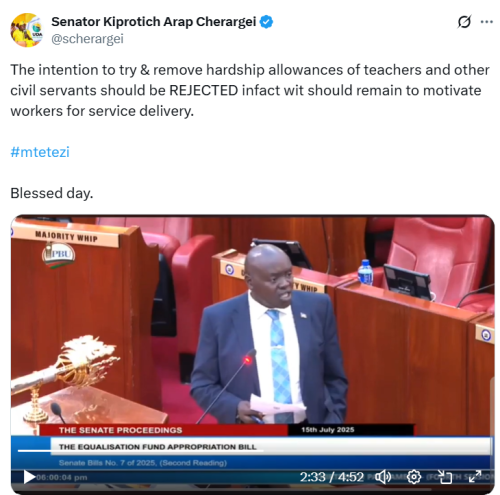
The senator urged the Senate Finance and Budget Committee to intervene. “I want to request through the vice chair, Senator Mutinda, that this issue of hardship allowance must be reviewed,” he said.
Cherargei also called for the expansion of the list of hardship areas to include more regions in Nandi County. He cited Terik, Chepterwo, Kapchorwa, Chemelil, and Chemase as areas that should be officially recognised as hardship zones to ensure fair compensation for workers stationed there.
His remarks align with the positions of the Kenya National Union of Teachers (KNUT) and the Kenya Union of Post Primary Education Teachers (KUPPET), both of which have rejected the proposal.
“In the spirit of equalisation and supporting marginalised areas, I agree with KNUT and KUPPET to reject the scrapping of hardship allowance,” he added.
Cherargei emphasised the importance of maintaining and even expanding the list of hardship zones. “We must fully disagree with the idea of removing hardship allowances for teachers and civil servants. There is a reason why 44 hardship areas were identified, and more should be included,” he said.
The debate highlights the ongoing challenge of ensuring equitable resource distribution and incentivising public service in Kenya’s most underserved regions.
Author
Latest News






Advertisement
More on Inside Politics