Advertisement
Global shocks drive Kenya’s revised 2026 growth outlook to 5 percent
Friday 12th June, 2026 12:20 AM|

Kenya has revised its economic growth projection for 2026 downward to 5 percent from an earlier estimate of 5.3 percent, citing ongoing global geopolitical tensions affecting energy markets, trade flows and supply chains.
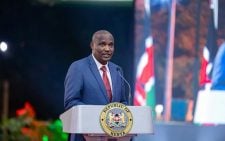
National Treasury and Economic Planning Cabinet Secretary John Mbadi announced the revision while presenting the Budget Policy Highlights for the 2026/27 financial year to a joint sitting of Parliament at the Parliament Buildings on July 11, 2026.
Mbadi said the budget framework is anchored on policy measures aimed at sustaining macroeconomic stability despite external shocks. He noted that global uncertainties continue to shape domestic inflation, fiscal planning and growth projections.
“The economy grew by 4.6% in 2025 compared to 4.7% in 2024, with all sectors registering positive growth. However, the 2026 growth outlook faces downside risks from emerging external shocks, particularly the conflict in the Middle East, leading to a downward revision of the growth projection to 5% from the earlier forecast of 5.3%,” noted the CS
Drivers of global economic pressure
You Might Also Like

The Cabinet Secretary pointed to the Russia-Ukraine conflict and heightened tensions in the Middle East involving Iran, Israel and the United States as major contributors to rising global oil prices. He said the developments have increased inflationary pressures across economies through higher energy, transport and food costs.
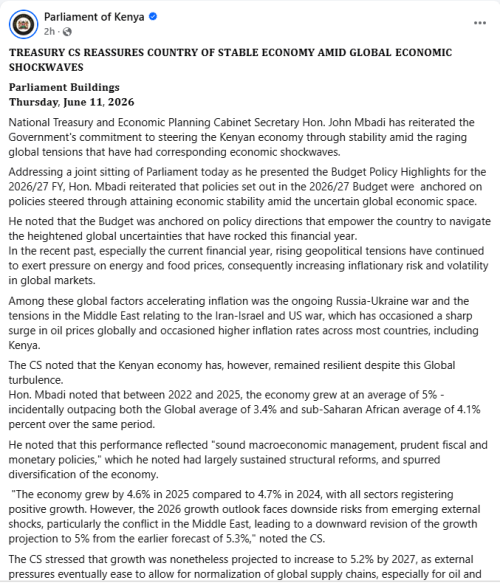
He added that Kenya’s economy remains resilient despite the external shocks, supported by sound macroeconomic management and ongoing structural reforms. Between 2022 and 2025, the economy recorded an average growth of 5 percent, outperforming the global average of 3.4 percent and the sub-Saharan Africa average of 4.1 percent.
Growth stood at 4.6 percent in 2025, slightly lower than 4.7 percent in 2024, with positive performance across all sectors.
Inflation and macroeconomic outlook
Mbadi said inflation rose to 6.7 percent in May 2026 from 3.8 percent in May 2025, largely driven by increased fuel prices. He noted that lower lending rates have supported recovery in private sector credit growth, while the Kenya Shilling has remained broadly stable.
The Nairobi Securities Exchange has also maintained strong performance, reflecting investor confidence. The external sector continues to benefit from strong remittance inflows, export earnings and services receipts, alongside adequate foreign exchange reserves that provide a buffer against external shocks.
Mbadi projected that economic growth will improve to 5.2 percent in 2027 as global supply chain disruptions ease and commodity prices stabilize. He said the 2026/27 budget will focus on strengthening resilience through diversification, fiscal discipline and targeted investments in productive sectors to sustain long-term growth.
Author
Latest News







Advertisement
More on Business