Advertisement
Willis Otieno blames governance failures for Kisumu fish deaths
Thursday 02nd October, 2025 06:27 PM|

Thousands of fish have died in Kisumu Bay, leaving cage fish farmers along Dunga Beach facing losses estimated at a million.
The deaths, which occurred over the weekend of September 28–29, have been attributed to environmental degradation, sparking fresh concerns about the regulation and governance of fisheries.
Lawyer Willis Otieno has, however, blamed systemic failures for the tragedy. “These are not natural accidents but failures of governance and regulation,” he said.
Otieno added that Safina’s manifesto would prioritise science-based aquaculture, curb industrial pollution in lakes, and restore ecological balance to safeguard fisheries as an economic pillar.
You Might Also Like



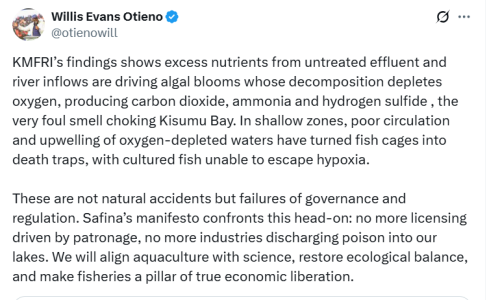
“Safina’s manifesto confronts this head-on: no more licensing driven by patronage, no more industries discharging poison into our lakes. We will align aquaculture with science, restore ecological balance, and make fisheries a pillar of true economic liberation,” read his X post dated October 2, 2025.
Research institute findings
The Kenya Marine and Fisheries Research Institute (KMFRI) linked the fish deaths to excessive nutrients in Kisumu Bay.
“KMFRI’s findings show excess nutrients from untreated effluent and river inflows are driving algal blooms whose decomposition depletes oxygen, producing carbon dioxide, ammonia and hydrogen sulphide, the very foul smell choking Kisumu Bay. In shallow zones, poor circulation and upwelling of oxygen-depleted waters have turned fish cages into death traps, with cultured fish unable to escape hypoxia,” Otieno wrote on his X.
According to their report, untreated effluent and river inflows triggered algal blooms, which, upon decomposition, depleted oxygen levels. This process released toxic gases, including carbon dioxide, ammonia, and hydrogen sulphide, causing the foul smell reported by residents.
KMFRI noted that in shallow waters, poor circulation and the upwelling of oxygen-depleted water created hypoxic conditions, turning cages into “death traps” where cultured fish, mainly tilapia, were unable to survive.
Joel Otieno, the immediate former chairperson of the Dunga Beach fish landing site, said water quality had deteriorated significantly in recent months. He attributed this to a newly opened canal directing raw sewage and domestic waste from nearby estates into Lake Victoria.
Farmers appeal for support
Each affected cage, estimated to be worth about Ksh 800,000, held thousands of tilapia. In total, 12 cages have been hit, intensifying losses for local farmers who have embraced cage fishing as an alternative to traditional methods amid declining natural stocks.
The farmers are now appealing to both county and national authorities for urgent intervention and possible compensation. Fisheries and public health officers have begun investigations, while Kisumu County Executive for Agriculture and Fisheries, Kenneth Onyango, assured that safe collection and disposal measures for the dead fish are underway.
Ken Okoth, a member of an affected group, dismissed suggestions of overstocking or poisoning, stating that their operations are closely monitored by government experts. Meanwhile, videos circulating online have warned against consuming fish from Dunga Beach, further raising concerns for the livelihoods of those dependent on Lake Victoria’s resources.
Author
Latest News






Advertisement
More on News