Advertisement
Kenya spends billions on disaster relief but still underfunds prevention – Treasury
Tuesday 21st July, 2026 11:06 PM|
Kenya has spent Ksh23.87 billion on emergency disaster relief over the past seven years, yet the country continues to underinvest in preventing the very disasters that repeatedly drain public finances, according to a new National Treasury strategy that calls for a fundamental rethink of how Kenya prepares for climate and natural hazards.
The Disaster Risk Financing Strategy 2026-2030 reveals that the country is caught in an expensive cycle of responding to disasters after they strike rather than investing enough to reduce their impact beforehand.
Between 2017 and 2023, the government spent about Ksh23.87 billion on emergency relief alone, excluding billions more required to rebuild damaged roads, schools, bridges, health facilities and other public infrastructure after disasters.
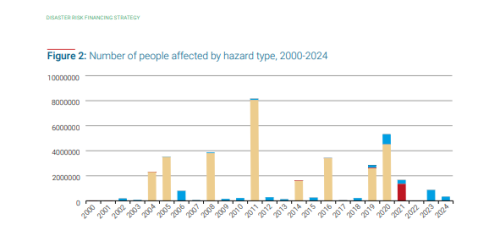
Yet despite the growing cost of floods, droughts and other climate shocks, the Treasury admits that financing for disaster preparedness remains inadequate.
You Might Also Like

“Financing for disasters is mainly reactive, significantly relying on ex-post budget reallocations, supplementary budgets and humanitarian assistance,” the strategy states.
That means government resources are often mobilised only after disasters occur, forcing ministries to divert funds from planned development programmes while emergency appeals are launched to fill financing gaps.
The strategy argues that this reactive approach is becoming increasingly unsustainable as climate-related disasters become more frequent and more expensive.
Impact of floods
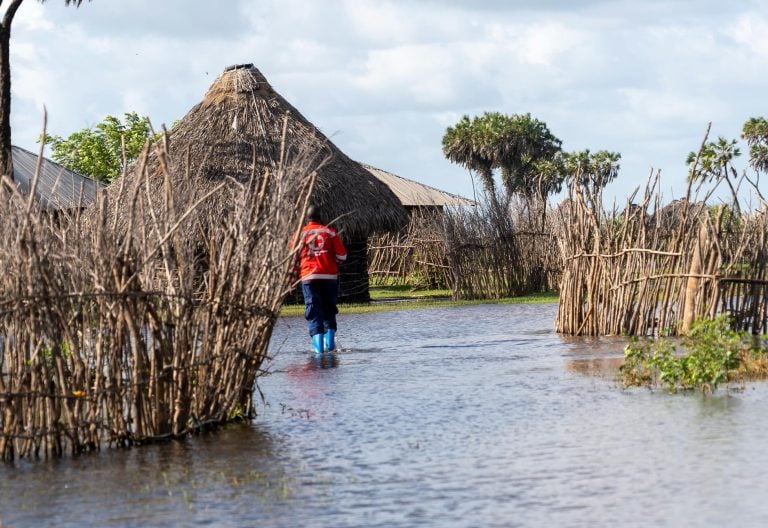
The warning comes barely months after the devastating October-December 2023 and March-May 2024 floods, which the Treasury estimates caused Ksh187.82 billion in damages and economic losses, making them among the costliest disasters in Kenya’s recent history.
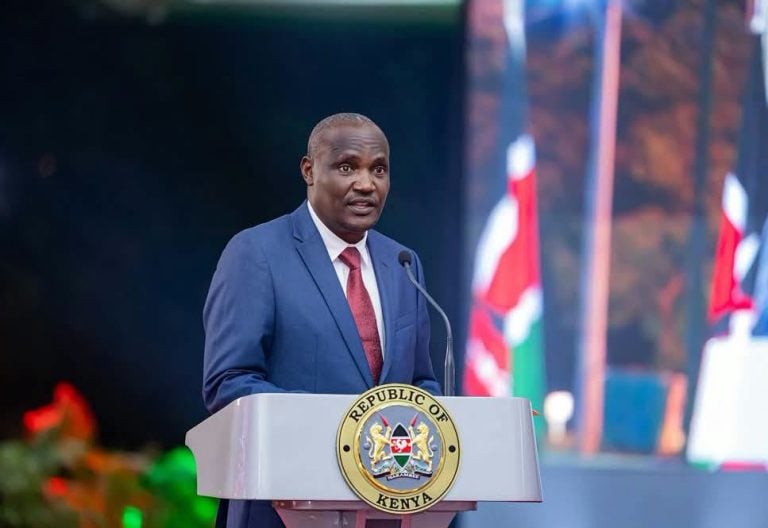
Treasury Cabinet Secretary John Mbadi says disasters are no longer simply humanitarian emergencies but a growing threat to national development and fiscal stability.

“Disasters continue to jeopardise the lives and livelihoods of people, national and county development, and economic stability,” Mbadi says in the foreword to the strategy.
The report notes that Kenya’s economy is particularly vulnerable because more than 30 per cent of Gross Domestic Product (GDP) and over 40 per cent of employment depend on climate-sensitive sectors, especially agriculture.
Every major drought or flood therefore reverberates far beyond affected communities, disrupting food production, infrastructure, trade and government revenues.
Despite these growing risks, the Treasury acknowledges that Kenya still lacks adequate financing for prevention and preparedness.
“There is currently no costed plan that quantifies the risk reduction investments required across different sectors in Kenya, making it difficult to assess the funding gap for prevention and preparedness,” the strategy says.
Financing challenge
Kenya’s climate adaptation needs are estimated at nearly Ksh5.7 trillion between 2020 and 2030, yet available climate finance remains far below that target.
As of 2018, the Treasury says total climate finance reached only about one-third of annual requirements, while just 11.7 per cent of that funding was directed towards adaptation and resilience.
The financing gap is widening as international support declines. The strategy notes that Official Development Assistance (ODA) fell by 23.1 per cent in 2025, the largest annual decline on record, reducing the external resources available for disaster response and climate resilience projects.
“This creates an urgent need to identify new and innovative sources of public and private finance to support financial resilience in Kenya,” the Treasury says.
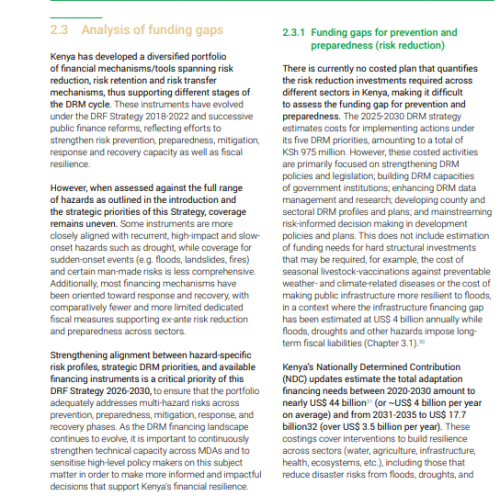
The report argues that public funds alone cannot close the gap and calls for greater private-sector investment through resilience lending, insurance products, blended finance, guarantees and catastrophe bonds.
Rather than relying on emergency spending after disasters occur, the Treasury wants Kenya to finance resilience before crises happen.
The strategy proposes a comprehensive financing framework built around three pillars, risk reduction, risk retention and risk transfer, that would increase investment in disaster prevention while ensuring emergency resources are pre-arranged instead of assembled after catastrophes.
It also seeks to strengthen county emergency funds, expand insurance coverage for climate-related risks and improve financial protection for vulnerable households.
The Treasury warns that unless Kenya shifts from reactive disaster financing to proactive resilience investment, the economic costs will continue to rise as climate change intensifies floods, droughts and other extreme weather events.
The strategy notes that preventing disasters is no longer simply an environmental or humanitarian objective; it has become an economic necessity.
Author
Latest News




Advertisement
More on Business