Advertisement
David Ndii and Willis Otieno clash over Kenya Pipeline governance and conflict of interest
Sunday 19th July, 2026 11:41 AM|

David Ndii and lawyer Willis Otieno have clashed over governance and conflict-of-interest concerns surrounding the Kenya Pipeline Company, with the two differing on whether its status as a public limited company settles questions raised over its dealings.
The exchange unfolded in statements shared on their X accounts on Sunday, July 19, 2026, after Ndii argued that Kenya Pipeline is not a State corporation but a public limited company, saying such entities can transact with companies in which their directors have an interest provided the potential conflict is disclosed, and the director recuses themselves from relevant committee and board meetings.
“For the umpteenth time Kenya Pipeline is not a State Corporation, it’s a PLC. PLCs do business with companies that directors have interest provided they disclose potential conflict and sit out committee and board meetings where it’s discussed,” Ndii said in a statement on X.
However, Otieno said the company’s classification as a PLC did not, by itself, resolve the governance concerns raised over the transaction.
Disclosure not enough
You Might Also Like


According to the lawyer, while directors of public limited companies may transact with companies in which they have an interest under applicable corporate governance frameworks, such arrangements remain subject to legal and fiduciary safeguards.
He said disclosure of a potential conflict and recusal from deliberations were necessary measures but did not automatically eliminate concerns over accountability or the perception of impartiality.
“The characterisation of Kenya Pipeline as a PLC does not, in itself, resolve the governance concerns that have been raised,” Otieno said.
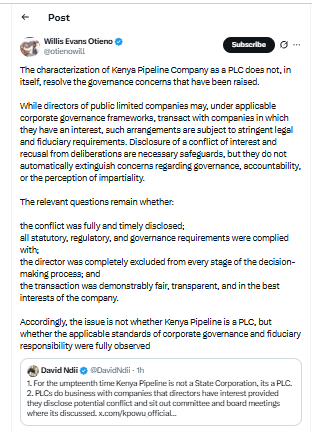
He argued that the key issue was whether all applicable legal and governance requirements had been fully observed.
Questions over transaction
Otieno said the relevant questions included whether the conflict was fully and timely disclosed and whether all statutory, regulatory and governance requirements had been met.
He also questioned whether the director concerned had been completely excluded from every stage of the decision-making process and whether the transaction was demonstrably fair, transparent and in the best interests of the company.
The lawyer maintained that the debate should therefore not focus solely on whether Kenya Pipeline is a public limited company.
“Accordingly, the issue is not whether Kenya Pipeline is a PLC, but whether the applicable standards of corporate governance and fiduciary responsibility were fully observed,” he said.

The exchange has reignited debate over the governance of public companies, the responsibilities of directors and the safeguards required when companies enter into transactions involving parties connected to members of their boards.
Author
Latest News








Advertisement
More on News