Advertisement
NTSA issues public safety advisory on wet weather
Friday 17th April, 2026 10:26 AM|

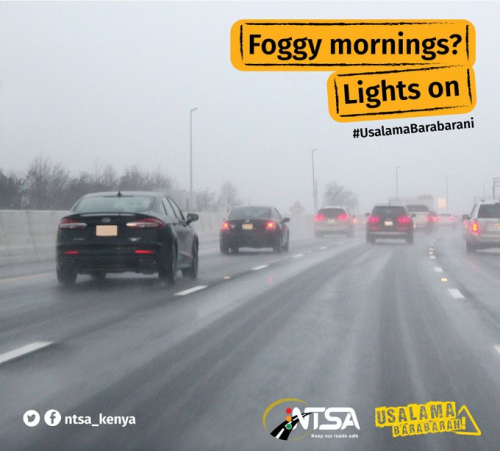
Drivers have been encouraged to exercise additional caution during rainy and foggy weather after the National Transport and Safety Authority (NTSA) issued a public safety advisory calling on them to use headlights and exercise caution in foggy, wet conditions.
In a statement on their X handle on Friday, April 17, 2026, NTSA, in a recent road safety message posted under the Usalama Barabarani campaign, has underscored the need to switch on headlights when in the fog in the mornings in an effort to enhance the visibility of all road users.
The warning is given at a time when less visibility and slippery roads are becoming issues of concern, particularly during heavy mist and rain.
“Stay safe in wet weather,” NTSA stated.
You Might Also Like


The warning reminds one of a very basic yet frequently neglected precaution. NTSA has consistently stated that the use of headlights not only enables drivers to have a better view of the road but also makes vehicles more conspicuous to other vehicles, thus minimising the chances of accidents.
Bad weather is also cited as a significant risk factor. Tyre traction may be greatly decreased by rainwater, and braking distances are extended, as are the chances to skid or splash. NTSA cautions that such, coupled with low visibility, can pose hazardous driving conditions to even experienced drivers.
The authority has encouraged drivers to drive slowly, keep a safe distance behind them and not to engage in sudden braking or sharp turning. The motorists are also advised to make sure that their vehicles are roadworthy with their lights, windscreen wipers and windows in good condition.
The NTSA campaign dubbed usalama barabarani has been maintained to ensure responsible road use throughout the nation, with the authority emphasising that it only takes small measures to save lives.
NTSA report on accidents
The latest reports by the National Transport and Safety Authority (NTSA) and other government briefings show that the road carnage crisis persists in Kenya, with the number of road deaths stubbornly high in 2025 and even early 2026.
The statistics paint a dismal picture of a nation where road safety issues are still a major problem despite the continuous implementation of enforcement and education initiatives.
Pedestrians are the most vulnerable group, with a huge percentage of the deaths. Then come motorcyclists, who have been the most vulnerable due to the rapid increase in boda boda transport in the country. The passengers and drivers also remain among the casualties.
Key routes prone to accidents
Key routes that have been severely affected are major highways and urban corridors, especially in the Nairobi metropolis, and major transport routes like the Thika Road and the Nakuru-Eldoret Highway. Counties such as Kiambu, Murang’a, Nakuru, and Nairobi are still reporting frequent and, in most cases, fatal crashes, a clear indication of the concentration of risk in the high-traffic areas.
The government, in its turn, has escalated the road safety efforts, such as the use of roadside inspections, speed enforcement, and crackdown on the non-compliant public service vehicles by the government through NTSA and law enforcement agencies. The introduction of additional surveillance systems, such as CCTV monitoring of major black spots, is also included in wider strategies aimed at curbing reckless driving and increasing compliance.
Author
Latest News







Advertisement
More on News