Advertisement
Gachagua impeachment case: Kaluma says Court of Appeal might overturn Ksh50M award to ex-DP
Tuesday 09th June, 2026 08:36 AM|

Homa Bay Town Member of Parliament (MP) Peter Kaluma has suggested that the Court of Appeal could overturn the High Court’s decision to award Ksh50 million to former Deputy President Rigathi Gachagua in connection with his impeachment case.
Taking to his official X account on Tuesday, June 9, 2026, Kaluma argued that the appellate court is likely to reassess the findings on fair hearing and procedural compliance and, in the process, revisit the compensation awarded by the High Court.
According to Kaluma, the central issue on appeal will be whether Gachagua was denied due process during the impeachment proceedings or whether constitutional requirements were adequately satisfied.
He maintained that the High Court erred in its determination and predicted that the appellate court would find that Gachagua was accorded a fair hearing throughout the process.
You Might Also Like


“When they appeal, the Appellate Court will find he was granted a fair hearing, reverse that wrong decision by the High Court in his favour and take away that money that has been awarded to him for nothing,” Kaluma stated.
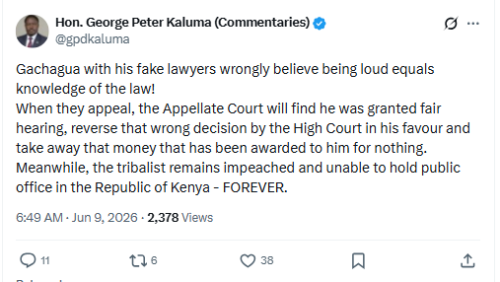
The legislator further insisted that the impeachment process remains constitutionally valid and that the ongoing legal contest will not alter Gachagua’s political status.
His remarks come amid ongoing national debate following the High Court judgement in the impeachment case, which has sparked divided interpretations among political leaders, lawyers, and analysts.
Some legal experts have noted that appellate courts often focus on whether procedural fairness was observed in legislative processes, especially in politically sensitive matters such as impeachment.
Gachagua’s political rights
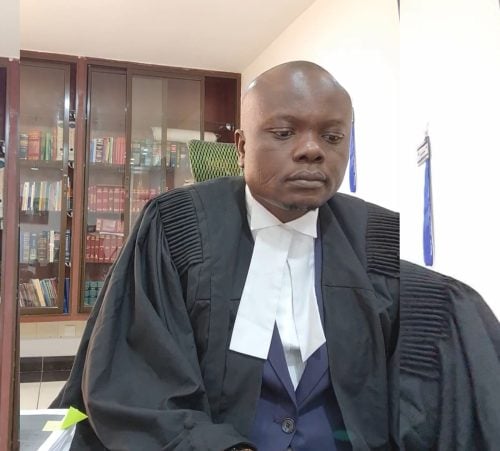
Lawyer Peter Wanyama has argued that Gachagua remains constitutionally eligible to contest the presidency despite a setback in the High Court in his impeachment case.
Taking to his official X account on Tuesday, June 9, 2026, hours after the court’s judgement on Gachagua’s impeachment, Wanyama maintained that the legal process is still ongoing and that the final determination of the former deputy president’s political future rests with the Supreme Court.
“The Constitution provides adequate safeguards, checks, and balances regarding the fate of the impeached Deputy President Rigathi Gachagua. His fate lies in the Supreme Court, not the High Court or the Court of Appeal,” Wanyama stated.
According to the lawyer, while Gachagua may have encountered legal hurdles at the High Court level, the Constitution protects his political rights until all available avenues of appeal have been exhausted.
At the same time, lawyer Willis Otieno argues that the ruling leaves unresolved legal contradictions that are likely to trigger further appeals.
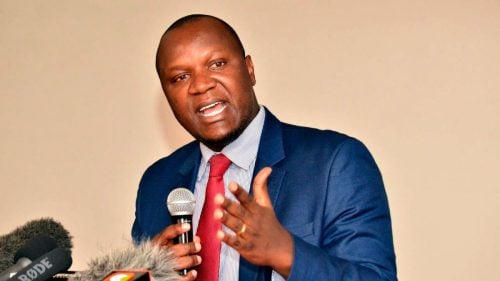
Taking to his official X account on Tuesday, June 9, 2026, Otieno questioned how the court could acknowledge violations of fair hearing and due process while, at the same time, preserving the validity of the Senate’s impeachment decision.
“The judgement appears to leave a significant tension unresolved,” Otieno stated.
According to the Safina deputy party leader, the right to a fair hearing is a central constitutional principle that directly affects the legitimacy of any legal or quasi-judicial process.
Otieno argued that many legal observers would naturally question how an impeachment process found to contain procedural flaws could still produce a legally sustainable outcome.
Gachagua impeachment case ruling
The High Court on Monday, June 8, 2026, upheld the impeachment of Gachagua but awarded him Ksh50 million in damages, finding that senators violated his right to a fair hearing during the proceedings.
In a judgement delivered at night, the court ruled that while the impeachment itself met the constitutional threshold and would stand, aspects of the process fell short of fair trial standards guaranteed under the Constitution.
The bench found that members of the Senate proceeded with hearings despite requests for an adjournment on medical grounds, concluding that the refusal to pause proceedings amounted to a violation of Gachagua’s right to a fair hearing.
The court said that although Parliament has broad constitutional authority to oversee and remove state officers, that power must be exercised in accordance with due process protections, including the right of an accused official to participate adequately in proceedings affecting their office and rights.
Gachagua’s camp is expected to continue pursuing legal remedies as the matter advances through the appellate process.
Kirinyaga Woman Representative and lawyer Njeri Maina described the High Court’s decision to uphold the impeachment of Gachagua as “gravely disappointing”, saying the legal team will challenge the judgement at the Court of Appeal.
Author
Mustafa Juma
View all posts by Mustafa JumaLatest News

Advertisement
More on News