Advertisement
EPRA announces fuel prices for March-April cycle
Saturday 14th March, 2026 06:12 PM|

The Energy and Petroleum Regulatory Authority (EPRA) has announced the fuel prices for the latest monthly review cycle covering March 15 to April 14, 2026.
In a statement issued on Saturday, March 14, 2026, in accordance with Section 101(y) of the Petroleum Act 2019 and Legal Notice No. 192 of 2022, the regulator said it had calculated the maximum retail prices of petroleum products applicable across the country for the next 30 days.
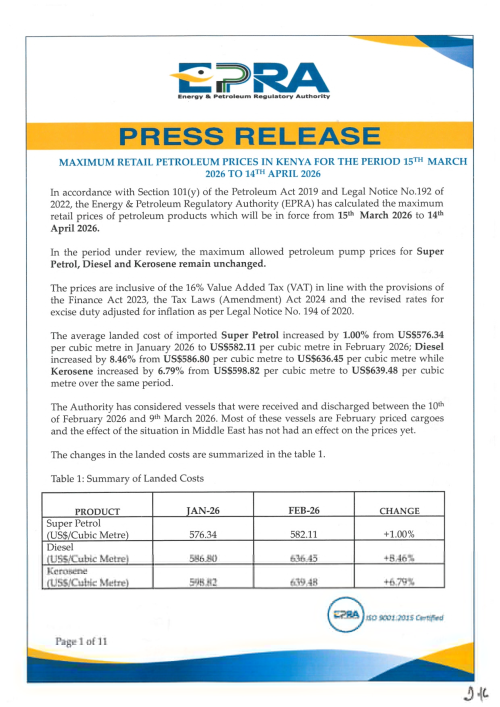
According to EPRA, the maximum allowed petroleum pump prices for Super Petrol, Diesel, and Kerosene remain unchanged for the period under review.
“In accordance with Section 101(y) of the Petroleum Act 2019 and Legal Notice No.192 of 2022, we have calculated the maximum retail prices of petroleum products which will be in force from 15th March 2026 to 14th April 2026. In the period under review, the maximum allowed petroleum pump prices for Super Petrol, Diesel, and Kerosene remain unchanged,” EPRA stated.
Fuel prices
You Might Also Like


Under the latest review, motorists and consumers in Nairobi will continue paying Ksh178.28 per litre of Super Petrol, Ksh166.54 per litre of Diesel, and Ksh152.78 per litre of Kerosene.
“In Nairobi, Super Petrol, Diesel, and Kerosene now retail at Kshs.178.28, Kshs.166.54, and Kshs.152.78 effective midnight for the next 30 days,” the authority said.
EPRA noted that the prices announced are inclusive of taxes and levies imposed under existing tax laws.
“The prices are inclusive of the 16% Value Added Tax (VAT) in line with the provisions of the Finance Act 2023, the Tax Laws (Amendment) Act 2024 and the revised rates for excise duty adjusted for inflation as per Legal Notice No. 194 of 2020,” the regulator added.
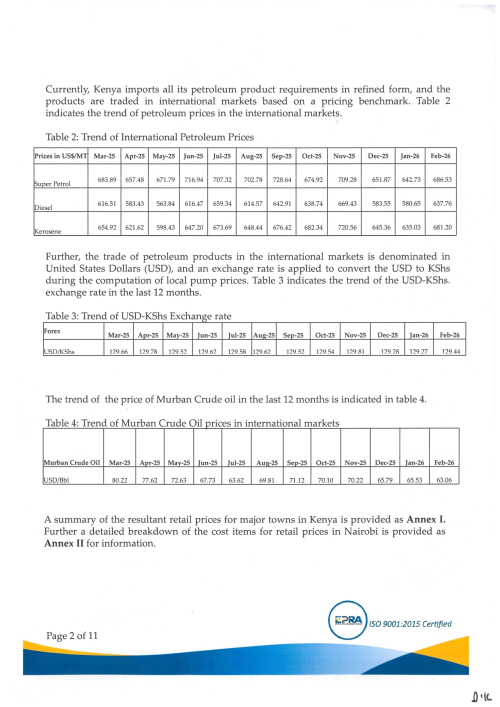
Kenya reviews fuel prices on a monthly basis, with EPRA setting maximum pump prices for petroleum products to reflect changes in international oil prices, exchange rates, and local taxes.
The regulator’s decision to retain prices for the March–April cycle is expected to offer temporary relief to consumers and businesses that rely heavily on fuel amid concerns following the conflict being witnessed in the Middle East.
Fears of fuel prices spike
This comes days after former Cabinet Secretary Moses Kuria dismissed fears of an imminent spike in fuel prices amid shortage concerns, with some critics arguing that the government is not prepared for the looming crisis.
Taking to his official X account on Thursday, March 12, 2026, the former president William Ruto’s senior economic advisor assured motorists that this week’s price review is unlikely to reflect the global oil market tensions that have triggered concern across the region.
Kuria said Kenya’s fuel pricing mechanism makes it impossible for global shocks to immediately affect pump prices, urging the public not to panic over speculation circulating online.
“In this era where everyone is an expert at everything, it’s tempting to doubt your own knowledge when the uninformed pose as professors. I understand the oil industry very well, having worked in the industry since 1994 and as a banker to the oil producers later. There is no way on earth there will be a major spike in the price of fuel in this week’s review,” Kuria stated.
According to Kuria, the country’s pricing system is based on the M-Minus One formula, meaning the prices set in a given month are determined by shipping costs from the previous month.
He explained that the March pricing cycle is largely based on February fuel shipments, which were dispatched before the escalation of tensions in the Middle East.
Author
Mustafa Juma
View all posts by Mustafa JumaLatest News








Advertisement
More on News