Advertisement
Bribery cases in key State bodies surge despite failing services
Friday 18th July, 2025 10:20 AM|
Corruption levels, particularly bribery, have recorded a notable spike under the Kenya Kwanza administration further raising concerns on the accountability and transparency of the different institutions.
This is despite the majority of Kenyans paying for services by the national government amid challenging economic times marked by inflation and shrinking spending power.
A new report by Transparency International (TI), a non-profit institution, shows that the bribery instances increased by 20 per cent to reach 84 per cent under the police service from 64 per cent last recorded in 2019.
The report, which sought to formulate empirical measure of bribery practices across the public sector showed that the aggregate rate was fuelled by the need to access services from the public sector. 34 per cent of sampled Kenyans noted this factor as the only possible way to access public services.
You Might Also Like


Taking the second position is the Lands sector where bribery instances increased from 32 per cent to 45 per cent between the 2019 and 2025 then closely followed by Motor Vehicle Licensing, which also increased from 21 per cent to 43.7 per cent.
The Judicial system was also flagged, where it was observed that 40.8 per cent bribery rate was recorded in 2025. Interestingly, the Judicial service had the highest average amount paid by Kenyans, standing at Sh18,800.
“The extractive value of the judiciary in terms of the power to extract bribes now becomes much higher, you get less indicated and the figure was actually much higher in 2019 at Sh24,000,” Mwangi Kibathi, a research consultant with TI said.
The Tax services side also recorded a notable increase with the rate having increased from 12 per cent to 28 per cent.
“The national share of bribe is now an indicator that seeks to tell us out of all the bribes that were reported having been paid by the respondents, approximately how much went to a particular institution,” Mwangi Kibathi, a research consultant with TI said during the presentation.
Deep-rooted problem
The Kenya Bribery Index 2025 reveals that the police were the worst ranked on the likelihood of encountering bribery with a score of 72 per cent with the Land services having 64.6 per cent, Civil Registration 62.4 per cent, Education Services 55.8 per cent and Business Licencing at 54.5 per cent, all ranked high above 50 percent.
Additionally, almost 40 per cent of the total bribes reported were paid to the police.
“This points to a deep-rooted corruption culture within the police force and highlights the urgent need for reforms and accountability,” Kibathi noted.
In terms of high average amounts, Judicial services was followed by the police service at Sh6,800 then followed by land services which had an average bribery amount of Sh1,600.
“So by and large the police have been leading in the other three indicators. When it comes to the average size of bribe, then it falls probably because of the kind of services they offer,” he explained.
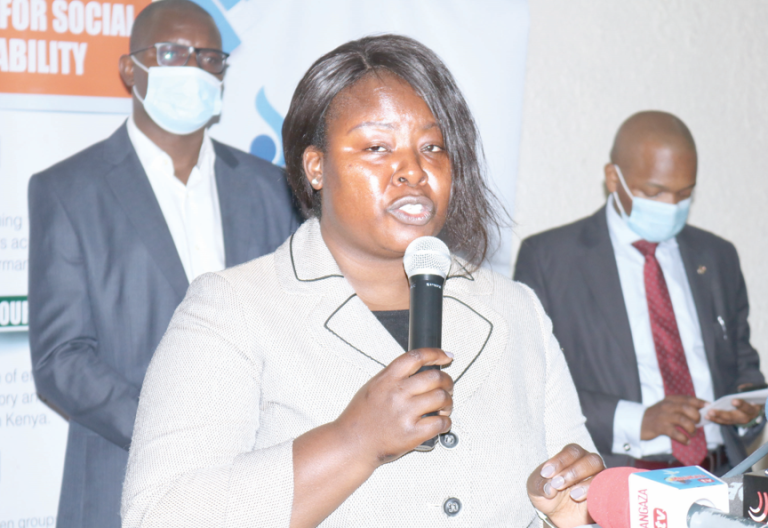
This trend according to Sheila Masinde, the executive director of Transparency International Kenya, questions the effectiveness of service delivery by the different government institutions.
“Basically, the concern around paying bribes to access services is what is the impact to Kenyans not just as we talked about the amount paid but also if you’re paying a bribe to get services what does it mean for those who are not paying bribes?” she questioned.
This factor again tends to affect Foreign Direct Investment (FDI) especially from countries that uphold integrity. A 2024 report by the US Department for Trade highlights corruption as the biggest factor limiting both their investment and exports in the Kenyan market.
“Majority of the US investors were unable to secure deals with some Kenyan government entities because of handouts. Then the process of setting up a company is quite lengthy with some officials demanding bribery to hasten the process,” she said.
According to Masinde, this aspect continues to slow down economic growth due to lack of job opportunities for the Kenyan citizens.
At the same time, bribery, according to the report, remains largely underreported with only 17 per cent of victims of these bribery incidents reporting their experiences in 2025, up from 6 per cent in 2017.
The primary reason cited by the 83 per cent who did not report was lack of trust in any meaningful follow-up action by the enforcement agencies, an issue raised by 47 per cent of respondents.
The situation has been the same across the years with 55 per cent and 47 per cent of the respondents citing the same reason in the 2019 and 2017 surveys respectively.
“This persistent lack of confidence in the mandated institutions continues to hinder accountability and allows corruption to thrive across the country,” Masinde noted.
While this happens, it was also established that elected leaders at the county level remain largely inaccessible to citizens, with citizens’ understanding of their leaders’ constitutional roles remaining limited, posing a disconnect in effective leader citizen engagement, diminishing the citizen oversight role, accountability, and quality service delivery offered at the counties.
“There’s very little awareness in regard to the role of the senator and the woman representative, which then raises a question, how do Kenyans hold accountable these particular offices or office duty bearers if they don’t understand their roles?” she questioned.
Author
Victor Mukabi
View all posts by Victor MukabiLatest News








Advertisement
More on News