Advertisement
Pay first! EACC reveals how bribery has become a primary requirement in Kenya
Thursday 09th April, 2026 01:32 PM|

In many government offices across the country, the first step to getting a service is no longer filling out a form or joining a queue. It is paying first.
A new survey dubbed Kenya Gender & Corruption Survey 2025 by the Ethics and Anti-Corruption Commission (EACC) reveals a shift in how corruption operates in public service delivery. Bribery is no longer an occasional wrongdoing by rogue officials.
It has quietly become a routine requirement, an unofficial entry ticket to services that citizens are legally entitled to receive.
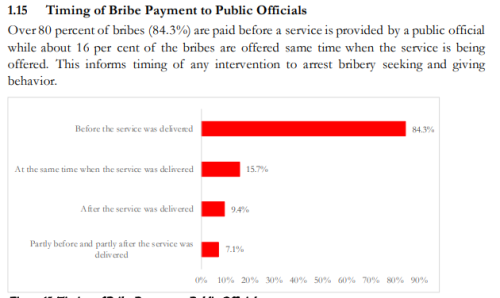
The findings released on Thursday, April 9, 2026, show that over 84 per cent of bribes are paid before a service is delivered, disclosing how corruption is now embedded at the very beginning of public interactions.
You Might Also Like



EACC says the delays are not always accidental. In some cases, they are deliberately created to pressure citizens into paying.
Participants in focus group discussions described how ordinary processes are slowed down until money changes hands.
“In practice, if you follow the normal process, it can take up to two weeks to get a birth and death certificate. But if you pay a bribe, often around 1,000 shillings, you can get it the same day. Civil Registration Officers deliberately create delays so that people are forced to pay more,” the report reads in a part.
This practice has turned public service delivery into a two-lane system, one slow and frustrating, the other fast but illegal.
Citizens who cannot afford to pay often wait longer, miss opportunities, or abandon their applications altogether.

The hidden mechanics of bribery
Behind closed doors, the mechanics of bribery are simple but effective. First comes the delay. Then comes the suggestion.
Sometimes, the survey says the demand is direct. Other times, it is subtle, a hint dropped by an officer or a broker hovering near the office door.
One respondent described how even life-saving services can be delayed without payment.

“If your child is critically ill, the only way to get urgent attention is either through bribery or by waiting and risking the patient’s condition worsening. That’s the painful reality,” a respondent in the survey said.
Such experiences reveal how corruption has moved beyond inconvenience to become a threat to health, safety and livelihoods.
EACC warns that the greatest danger is not the amount of money lost, but the normalisation of corruption.
The survey found that many citizens no longer see bribery as shocking. Instead, it is viewed as part of the process, a cost that must be paid to move forward.
Some citizens even avoid reporting corruption because they believe nothing will change.
About one-third of respondents said they did not report bribery because they felt it was useless and nobody would care.
This silence allows the system to continue operating unchecked.
Author
Latest News








Advertisement
More on News