Advertisement
Agriculture still anchors Kenya’s economy despite tourism and industry gains – KNBS
Saturday 11th July, 2026 12:06 AM|
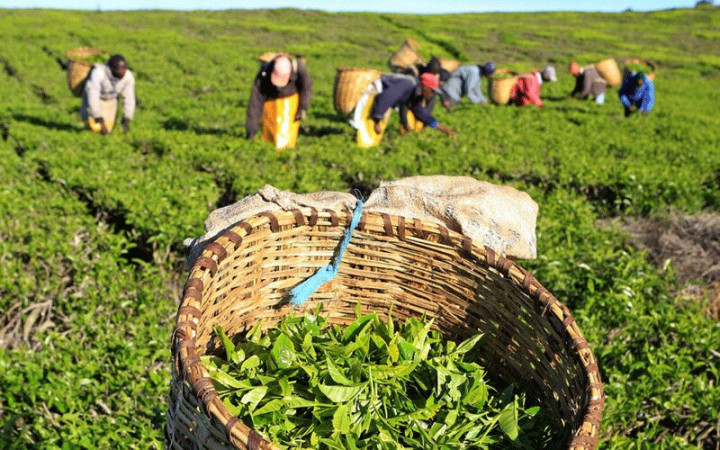
Kenya’s agriculture sector maintained its position as the backbone of the economy in the first quarter of 2026, delivering steady growth and supporting millions of livelihoods even as tourism, construction and manufacturing emerged among the fastest-growing sectors.
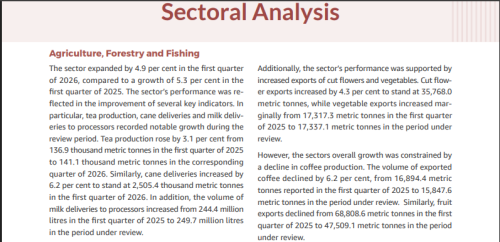
According to the latest Quarterly Gross Domestic Product (GDP) Report released by the Kenya National Bureau of Statistics (KNBS), agriculture, forestry and fishing activities expanded by 4.9 per cent during the first quarter of 2026, matching the overall pace of economic growth and reaffirming the sector’s critical role in Kenya’s economic performance.
While much attention has focused on the double-digit growth recorded in tourism and strong gains in construction and manufacturing, agriculture remains Kenya’s largest employer and one of the country’s most important sources of food security, export earnings and rural incomes.
“Agriculture, Forestry and Fishing activities recorded a growth of 4.9 per cent in the first quarter of 2026 compared to a growth of 5.3 per cent in the corresponding quarter of 2025,” KNBS said in the report.
You Might Also Like


The sector’s performance was supported by increased production in key agricultural value chains, particularly tea, dairy and sugarcane farming.
KNBS reported that tea production increased during the quarter, boosting one of Kenya’s leading foreign exchange earners. The improvement is expected to benefit tea-growing counties such as Kericho, Bomet, Nandi and Nyamira, where thousands of farmers depend on the crop for income.
Tea remains one of Kenya’s most important agricultural exports and continues to play a major role in supporting rural economies and earning foreign exchange for the country.
The dairy sector also posted encouraging results, with milk deliveries to processors increasing during the review period. The growth reflects sustained demand for processed dairy products and improved production among farmers.
The positive performance is particularly significant for leading dairy-producing counties including Nyandarua, Nakuru, Uasin Gishu and Kiambu, where milk production forms a major part of local economic activity.
The dairy sector is widely regarded as one of the most resilient segments of Kenya’s agricultural economy because it provides farmers with regular income throughout the year while supporting processors, transporters and retailers across the value chain.
Food security
Sugarcane farming also contributed to the sector’s growth, with KNBS reporting higher cane deliveries during the quarter. The increase offers positive signals for Kenya’s sugar industry, which remains an important economic driver in western Kenya.

Counties such as Kakamega, Bungoma, Busia, Kisumu and Migori continue to rely heavily on sugarcane farming and related industries for employment and household incomes.
The broad-based gains across tea, dairy and sugar production helped offset weaker performance in some agricultural activities. KNBS noted that coffee production and fruit exports declined during the quarter, partially moderating overall sector growth.
Despite these challenges, agriculture continued to provide a stable foundation for Kenya’s economy at a time when other sectors remained vulnerable to global market fluctuations and changing consumer demand.
The sector’s importance extends beyond economic output. Agriculture directly supports millions of households, provides raw materials for manufacturing industries and contributes significantly to national food security.
As Kenya pursues broader economic growth, the latest KNBS data highlights the enduring importance of agriculture in sustaining rural livelihoods and supporting national development.
While tourism, construction and manufacturing may have recorded some of the fastest growth rates in the first quarter of 2026, agriculture remains the engine that powers much of Kenya’s economy. Its continued expansion underscores why the sector remains central to the country’s long-term growth strategy and economic resilience.
Author
Latest News




Advertisement
More on Business