Advertisement
KRA posts record Ksh2.84T revenue collection in FY2025/26
Friday 10th July, 2026 04:40 PM|

The Kenya Revenue Authority (KRA) collected a record Ksh2.844 trillion in revenue during the 2025/26 Financial Year, posting its strongest growth in recent years as improved tax administration and compliance measures boosted collections.
According to the authority, revenue grew by 10.6 per cent, translating to an additional Ksh272.9 billion compared to the Ksh2.572 trillion collected in the 2024/25 financial year. The growth exceeded the 6.8 per cent recorded in the previous year.
Exchequer revenue increased by 10.5 per cent to Ksh2.568 trillion, while agency revenue rose by 11.2 per cent to Ksh276.1 billion.
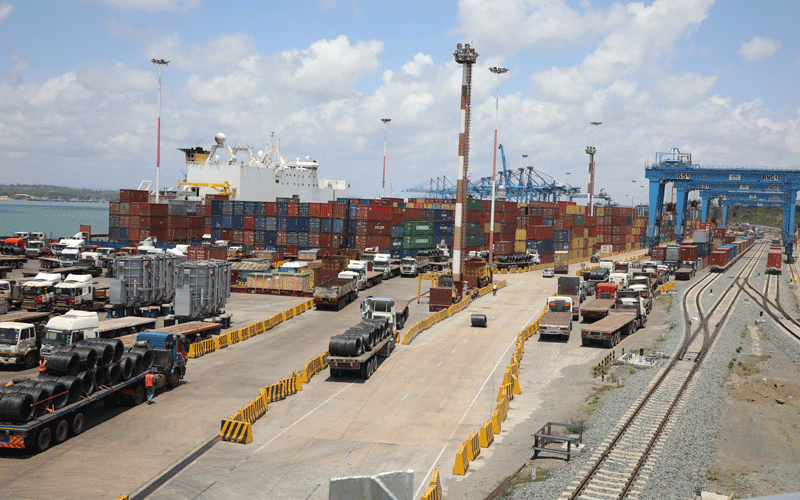
KRA also surpassed its customs revenue target after collecting Ksh988.8 billion against a target of Ksh980.8 billion, representing a performance rate of 100.8 per cent. Domestic revenue reached Ksh1.851 trillion, equivalent to 93 per cent of the target set for the financial year.
Key collections
You Might Also Like



The authority attributed the strong performance to sustained growth across key sectors of the economy and improved tax compliance.
Manufacturing, Energy, Financial and Insurance, Information and Communication Technology (ICT), and Wholesale and Retail Trade contributed about 62 per cent of total revenue despite accounting for 27.4 per cent of the country’s nominal Gross Domestic Product (GDP).
Manufacturing remained the largest contributor, generating Ksh462 billion, a 9.2 per cent increase from the previous year.
The Energy sector followed with Ksh445 billion, reflecting a 9.1 per cent increase, supported largely by customs taxes on petroleum products.
Financial and Insurance activities generated Ksh320 billion, while Wholesale and Retail Trade contributed Ksh288 billion after registering a growth of 10.3 per cent. The ICT sector collected Ksh248 billion, representing a 7.9 per cent increase.

Other sectors that recorded notable growth included Transport, Construction and Real Estate.
Among individual tax heads, Corporation Tax recorded the highest growth, rising by 14 per cent to Ksh347.1 billion.
Pay As You Earn (PAYE) collections increased by 6.7 per cent to Ksh598.8 billion, while Domestic Value Added Tax (VAT) reached Ksh355.3 billion after growing by 8.5 per cent.
Excise Duty on betting services rose to Ksh16.5 billion, reflecting a 24.9 per cent increase and surpassing the annual target with a performance rate of 115.9 per cent.
The Significant Economic Presence Tax (SEPT) doubled to Ksh1.6 billion following the expansion of its scope under the Finance Act 2025.
Digital systems enhance compliance
KRA said digital transformation continued to play a major role in improving revenue collection during the year.
The authority cited wider adoption of the Electronic Tax Invoice Management System (eTIMS), integration of iTax, iCMS and IFMIS platforms, use of artificial intelligence analytics, deployment of non-intrusive cargo scanners, pre-populated tax returns and real-time monitoring of betting firms among measures that strengthened compliance.
Additional initiatives included debt recovery, which realised Ksh144.8 billion, alternative dispute resolution mechanisms, expansion of the tax base and improved cargo clearance, with average clearance time reduced to 42.3 hours.
The revenue performance was recorded during a period when Kenya’s economy expanded by 4.6 per cent in 2025, supported by a stable exchange rate, improved private sector credit and increased imports.
Looking ahead, KRA said it plans to scale up electronic invoicing, establish a Data Analytics Centre of Excellence, deploy additional artificial intelligence tools, introduce Virtual Electronic Tax Registers and expand digital taxpayer services, including Ushuru GPT.
The authority thanked compliant taxpayers for their contribution, saying their continued support remains essential in financing the country’s development programmes.
Author
Latest News







Advertisement
More on Business