Advertisement
KNBS reveals why soap, tissue and detergents are driving Kenya’s cost-of-living crisis
Friday 03rd July, 2026 09:54 PM|

As Kenyans grapple with a rising cost of living, public attention has largely focused on soaring food prices and transport costs.
However, the latest Kenya National Bureau of Statistics (KNBS) Consumer Price Indices and Inflation Report reveals another, less-discussed burden on household budgets: the steady increase in the cost of everyday essentials such as detergents, soap, tissue paper, and personal care products.
While these items rarely dominate inflation headlines, they are becoming increasingly expensive, forcing many families to rethink spending on basic hygiene and household maintenance.
The June 2026 KNBS report shows that prices of several household necessities continued to rise between May and June. Detergents recorded one of the sharpest monthly increases, rising 2.2 per cent, while prices of dishwashing paste and liquid increased by 2.0 per cent and laundry soap by 0.5 per cent.
You Might Also Like



The bureau also reported higher prices for body lotion, hair oil and cream, alongside a 1.4 per cent increase in toilet paper and tissue paper.
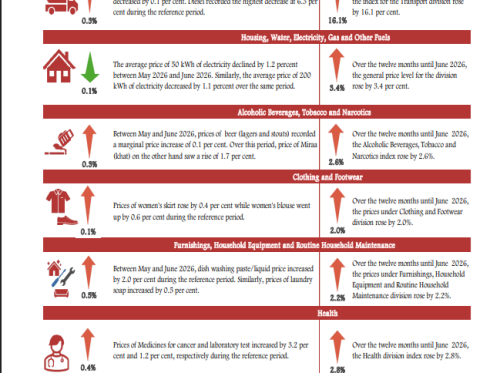
“Between May and June 2026, dishwashing paste/liquid price increased by 2.0 per cent during the reference period. Similarly, prices of laundry soap increased by 0.5 per cent,” KNBS said.
“Prices of body lotion and hair oil/cream both increased by 0.8 while toilet paper/tissue paper rose by 1.4 per cent.”
Although these individual increases may appear modest, consumer analysts say they add up over time because they affect the products households purchase every week or month.
Unlike discretionary spending, cleaning supplies and personal hygiene products are difficult to eliminate. Families may postpone buying new clothes or entertainment, but soap, detergent, tissue paper and basic toiletries remain essential for daily living.
Inflation
The findings come as Kenya’s annual inflation reached 6.4 per cent in June, driven mainly by higher prices in food, transport and housing-related expenses. Together, these three categories account for more than 57 per cent of household expenditure, leaving little room for families to absorb additional increases in everyday essentials.

/Youtube
The report suggests that the country’s cost-of-living crisis extends well beyond food inflation. As prices rise across multiple categories simultaneously, households are increasingly making difficult choices about where to cut spending. One consequence could be a gradual shift towards cheaper or lower-quality cleaning products, using smaller quantities of detergent, delaying purchases of toiletries, or sharing household essentials among family members to stretch limited incomes.
Public health experts have previously warned that prolonged reductions in spending on hygiene products could have unintended health consequences, particularly in densely populated urban settlements where access to sanitation is already constrained.
The KNBS data also reflects broader inflationary pressure across household maintenance. The Furnishings, Household Equipment and Routine Household Maintenance division recorded annual inflation of 2.2 per cent, revealing the growing cost of maintaining a home beyond rent and utility bills.
For supermarkets and manufacturers, the gradual rise in prices may also influence consumer behaviour, with shoppers increasingly switching to smaller package sizes, supermarket own brands or promotional offers to manage monthly budgets.
While food inflation often dominates public debate, the latest KNBS figures highlight a quieter trend unfolding on supermarket shelves.
The rising cost of other everyday essentials is steadily adding pressure to household finances, suggesting that Kenya’s cost-of-living challenge is no longer confined to what’s on the dinner table, but increasingly extends to the products families rely on to keep their homes clean, healthy and functioning every day.
Author
Latest News




Advertisement
More on Business