Advertisement
Willis Otieno: Foreign interests should not override Kenya’s accountability
Friday 05th June, 2026 06:39 AM|

Lawyer Willis Otieno has raised concerns over what he describes as a growing pattern where foreign partnerships and external interests are increasingly being used in ways that risk weakening Kenya’s constitutional processes and domestic accountability, amid continuing debate over the proposed Ebola quarantine facility in Laikipia.
Speaking in a statement shared on her X account on Friday, June 05, 2026, Otieno argued that while international cooperation remains important, government decisions affecting citizens should not be framed in a way that creates the impression that responsibility lies outside the country’s own institutions and leadership.
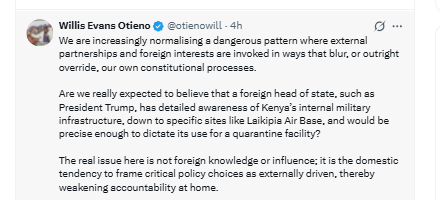
Otieno questions foreign influence narrative
Otieno warned that Kenya must remain cautious about narratives that appear to shift responsibility for domestic decisions to foreign powers.
“We are increasingly normalising a dangerous pattern where external partnerships and foreign interests are invoked in ways that blur, or outright override, our own constitutional processes,” he stated.
You Might Also Like


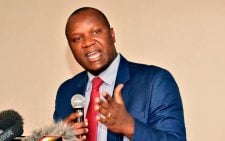
He questioned claims suggesting that foreign leaders would have detailed operational knowledge of Kenya’s internal structures and facilities.
“Are we really expected to believe that a foreign head of state such as President Trump has detailed awareness of Kenya’s internal military infrastructure, down to specific sites like Laikipia Air Base, and would be precise enough to dictate its use for a quarantine facility?” he posed.
According to Otieno, the concern is not necessarily external cooperation itself but how government decisions are communicated to citizens.
“The real issue here is not foreign knowledge or influence; it is the domestic tendency to frame critical policy choices as externally driven, thereby weakening accountability at home,” he added.
Muluka raises sovereignty concerns
Otieno’s remarks mirror sentiments raised by Democratic National Alliance Secretary General Barrack Muluka, who recently argued that sovereignty and self-determination remain central to Kenya’s constitutional framework.
“When we talk about sovereignty, the self-determination that came to us in June 1963, we secured the right to self-determination,” Muluka said during an interview on a local station on Thursday, June 4, 2026.
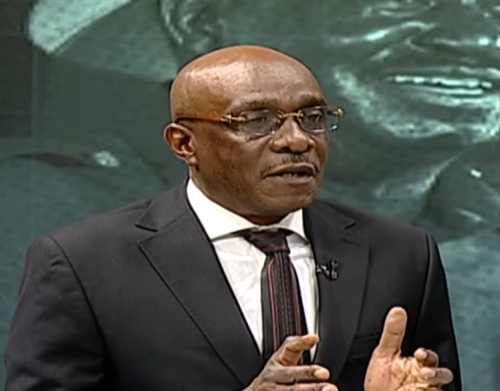
He further insisted that citizens remain the ultimate source of authority in government decisions.
“Our sovereignty, where the Constitution of Kenya says it rests with the people. The people are supreme,” Muluka stated.
Government defends Ebola facility
The government has, however, maintained that the proposed Ebola preparedness measures are guided by public health concerns rather than politics.
Health Cabinet Secretary Aden Duale recently dismissed opposition to the proposed facility, saying the government would not allow demonstrations or political pressure to derail national health preparedness efforts.
“This is not about President Ruto. Those are paid protesters,” Duale stated.
As debate continues, the discussion appears to be expanding beyond Ebola preparedness itself into broader questions of public trust, accountability and the extent to which foreign partnerships should shape decisions affecting Kenyan citizens.
Author
Latest News







Advertisement
More on News