Advertisement
Why Kenyan voters still reward visible development despite integrity concerns
Friday 22nd May, 2026 04:59 PM|

As Kenya edges closer to the 2027 General Election, a new political reality is emerging across urban counties: voters are increasingly rewarding leaders they can physically see working in their communities, even as concerns over accountability and corruption persist.
A new survey released by Kenyan research organisation Darubini poll paints a picture of an electorate that is becoming more politically aware, more development-conscious, and more focused on direct service delivery than ever before.
The May 2026 national survey, conducted through face-to-face household interviews between May 16 and May 19, sampled 500 adults in each targeted county, including Nairobi, Kisumu, Nakuru, Mombasa, Kilifi, Kwale, and Kakamega. The findings reveal that visible development projects, social welfare programmes, and grassroots interaction are shaping voter preferences ahead of the 2027 race.
Nairobi gubernatorial race
At the centre of the findings is Johnson Sakaja, who emerged as the most preferred gubernatorial candidate in Nairobi County with 48 per cent support, far ahead of James Gakuya at 28 per cent and Babu Owino at 17 per cent. But beyond the numbers lies a deeper political shift.
You Might Also Like

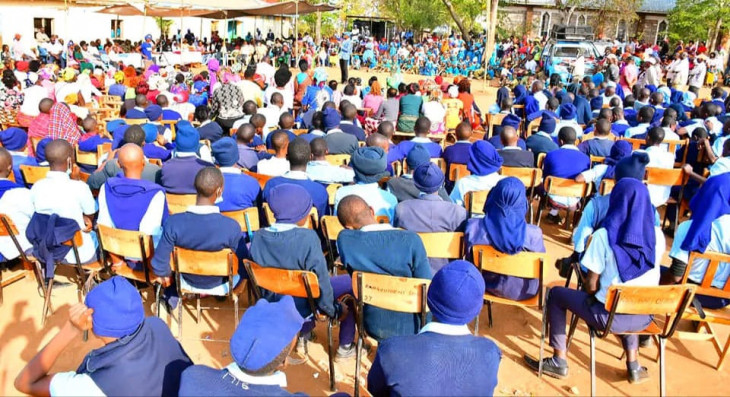

The survey suggests Nairobi voters are increasingly linking political leadership to everyday survival needs, particularly in low-income communities where food security and access to basic services remain major concerns.
According to the report, Sakaja’s popularity has been boosted by the county’s Dishi na County school feeding programme, which provides subsidised meals to public school learners. Researchers found that many families benefiting from the programme now associate the governor directly with household relief during difficult economic times.
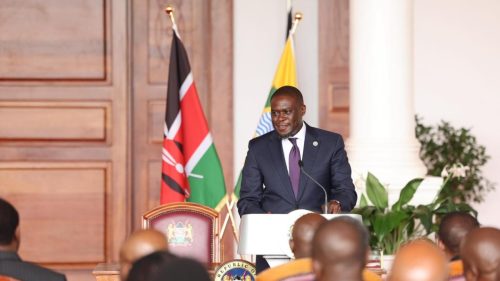
“We found that a lot of people went for Sakaja because he brought in stuff like Dishi na County, which really helped students in the public schools and even the needy,” Michael Andrew Otieno said, speaking on behalf of the research institution.
“So you find a student who only pays a small amount of money, and they get to have a meal,” he added.
The findings also show that about 58 per cent of respondents recognised ward-based road projects associated with the Nairobi county administration, reinforcing the growing importance of visible infrastructure in shaping public perception.
Yet the report also exposes a contradiction that has long defined Kenyan politics: voters often continue supporting leaders despite concerns about integrity.
Otieno noted that many Kenyans judge leaders primarily through direct interaction and service delivery rather than broader governance questions.
“We figured out that voters end up choosing leaders who sometimes end up being corrupt, but it’s mostly because of how these leaders are interacting with the people on the ground,” he said.
“And also, in terms of the service delivery they give us. So you find a leader has good service delivery, a leader is really good at interacting with his people, and at the end of the day it ends up being that kind of leader who ends up making the trust.”
Political analysts say this reflects a transactional style of politics that continues to dominate urban Kenya, where struggling households prioritise immediate development gains over abstract promises of accountability.
Demographic and ethnic alignments
The survey further shows how demographic and ethnic alignments are still influencing electoral contests despite the growing focus on development.
In Nairobi, Gakuya’s support was strongest among Mount Kenya voters, while Babu Owino attracted significant backing from younger voters living in informal settlements.
In Kisumu County, the race to succeed outgoing Governor Anyang’ Nyong’o is already taking shape. Senior Counsel Tom Ojienda led with 40 per cent support as many respondents expressed confidence in his ability to steer the county after Nyong’o’s final term.
However, the survey also points to possible internal tensions within the Orange Democratic Movement, particularly around the ambitions of Ruth Odinga. More than half of respondents believed internal ODM politics would ultimately determine her political future.
Meanwhile, in Nakuru County, Governor Susan Kihika maintained a commanding lead with 42 per cent support, boosted largely by support from women voters who cited healthcare programmes and her anti-gender-based violence advocacy.

Respondents also pointed to the county’s Ksh100 million Wezesha Fund, targeting small businesses, as a key factor behind her growing popularity.
The survey concludes that incumbents associated with visible projects and welfare programmes still hold a strong advantage over challengers. It also found that party affiliations and national political alignments remain powerful influences in voter decision-making.
For DARUBINI POLL, the research is only the beginning of a broader long-term political tracking initiative.
“As a research institution, it has been our long-year plan,” said Otieno. “We shall continue with the research and come up with books and release them after every four months.”
As the 2027 contest slowly takes shape, the findings suggest Kenya’s urban voter may be evolving but not entirely abandoning old political instincts. Development now matters deeply, but personality, ethnicity and political networks still remain firmly embedded in the country’s electoral culture.
Author
Lavender Kusimba
View all posts by Lavender KusimbaLatest News







Advertisement
More on News