Advertisement
EACC urges collective action in fight against governance challenges
Tuesday 14th April, 2026 12:48 AM|

The Ethics and Anti-Corruption Commission (EACC) has called for collective action in addressing governance challenges, stating that corruption and accountability gaps require coordinated efforts across institutions.
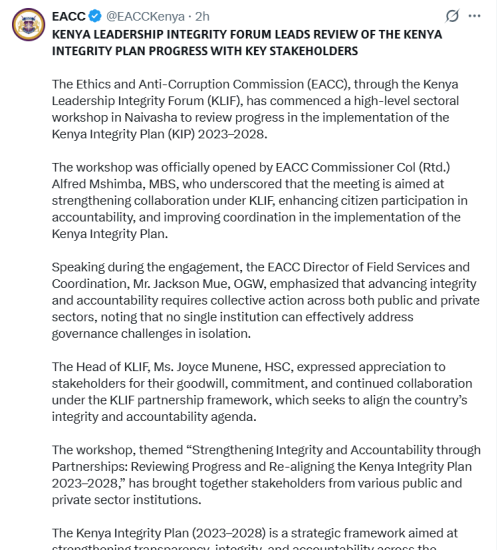
The call was made during a high-level sectoral workshop held in Naivasha on April 13, 2026, under the Kenya Leadership Integrity Forum (KLIF).
The meeting reviewed progress on the implementation of the Kenya Integrity Plan (KIP) 2023–2028, a framework aimed at strengthening transparency, integrity, and accountability across public and private sectors.
Speaking during the engagement, the EACC Director of Field Services and Coordination, Jackson Mue, emphasised that advancing integrity and accountability requires collective action across both public and private sectors, noting that no single institution can effectively address governance challenges in isolation.
You Might Also Like

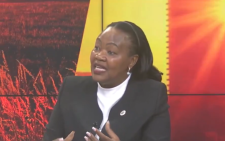
“Jackson Mue emphasised that advancing integrity and accountability requires collective action across both public and private sectors, noting that no single institution can effectively address governance challenges in isolation,” read the X post in part.
Workshop opening and participation
The workshop was officially opened by EACC Commissioner Alfred Mshimba and brought together representatives from government agencies, private sector organisations, civil society, and development partners.
Themed “Strengthening Integrity and Accountability through Partnerships: Reviewing Progress and Re-aligning the Kenya Integrity Plan 2023–2028,” the forum assessed implementation progress, identified gaps, and considered areas for improved coordination.
The Kenya Leadership Integrity Forum (KLIF) facilitated discussions aimed at aligning institutional efforts under the national integrity framework.
EACC Director of Field Services and Coordination Jackson Mue and KLIF Head Joyce Munene also participated in the discussions, which focused on strengthening cooperation between institutions involved in governance and accountability initiatives.
Survey findings on service delivery and accountability
The workshop also considered findings from the Kenya National Gender & Corruption Survey 2025, released on April 9, 2026.
The report indicates that a significant proportion of bribes are paid before services are rendered, particularly in areas such as civil registration, health services, immigration, and revenue administration.
The findings show that delays in service delivery are frequently cited as a contributing factor, with some applicants reporting faster processing when informal payments are made.
The survey also notes low reporting rates, with most respondents indicating they do not report bribery incidents to authorities.
This trend was discussed in relation to ongoing efforts under the Kenya Integrity Plan to strengthen reporting systems, improve service delivery processes, and enhance institutional accountability mechanisms across sectors.
Author
Latest News







Advertisement
More on News