Advertisement
UN report exposes deep global capital imbalance as Africa struggles to attract investment
Saturday 20th June, 2026 12:58 AM|
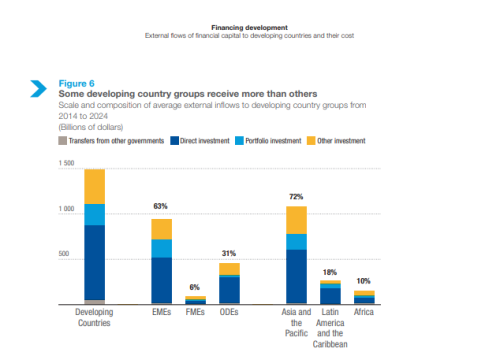
Africa is home to more than one-fifth of the developing world’s population and nearly four in every 10 developing countries, yet it attracts just 10 per cent of financial inflows to developing economies, according to a new United Nations report that reveals the continent’s growing struggle to compete for global capital.
The findings, contained in a report by the United Nations Conference on Trade and Development (UNCTAD), expose a stark imbalance in the distribution of international finance at a time when African countries are seeking billions of shillings to fund infrastructure, industrialisation, climate adaptation and job creation.
According to the report, Africa accounts for 38 per cent of all developing countries and 22 per cent of the developing world’s population. However, the continent receives only 10 per cent of total external financial inflows.
By contrast, Asia attracts more than 70 per cent of all financial inflows to developing economies.
You Might Also Like



The disparity raises questions about why global investors continue to favour countries such as India, Vietnam and Indonesia while much of Africa remains on the sidelines of international capital flows.
The report notes that financial resources remain heavily concentrated in a small number of developing economies that have stronger industrial bases, deeper capital markets and greater integration into global supply chains.
For Africa, the consequences are significant as limited access to foreign investment means governments and businesses have fewer resources available for expanding industries, creating jobs, building infrastructure and financing development priorities.
The challenge comes as many African economies are already facing rising debt-servicing costs, shrinking fiscal space and increasing competition for international investment capital.
UNCTAD warns that global financial flows remain highly uneven despite decades of economic integration.

The report shows that developing countries collectively attracted substantial external financial resources over the past decade, but the overwhelming majority flowed to Asia and a handful of large emerging economies.
For Kenya, the findings underscore both an opportunity and a challenge.
As East Africa’s largest economy and a regional financial hub, Kenya has long positioned itself as a gateway for investment into the wider region. Nairobi hosts regional headquarters for multinational corporations, international organisations and technology firms seeking access to East African markets.
Yet Kenya is increasingly competing against fast-growing Asian economies that continue attracting significantly larger shares of global capital.
Trade imbalance
Countries such as India, Vietnam and Indonesia have benefited from manufacturing expansion, export-oriented industrial policies, strong integration into global value chains and aggressive investment promotion strategies.
Their success has enabled them to attract larger volumes of foreign direct investment, portfolio flows and development finance.
The UN report suggests that Africa’s relatively low share of global capital reflects structural challenges that continue to discourage investors, including infrastructure gaps, high financing costs, market fragmentation and perceptions of risk.
For Kenya, analysts say attracting a larger share of international investment will require reforms aimed at lowering the cost of doing business, improving regulatory predictability, strengthening investor protections and accelerating infrastructure development.
The report also highlights the importance of leveraging investment beyond financing alone.
“It is important that recipient countries optimise the non-financial benefits of equity flows, including integration into global value chains and skills and technology transfer,” UNCTAD says.
This means attracting investment that not only brings capital but also creates jobs, expands exports and transfers technology to local industries.
As governments across Africa seek financing for industrialisation, green energy projects and climate resilience, the UN findings suggest the continent faces a critical challenge.
Despite representing nearly a quarter of the developing world’s population, Africa remains a minor destination for global capital.
The question for policymakers in Nairobi and across the continent is no longer how to attract investment, but how to compete more effectively in a world where most development finance continues to flow elsewhere.
Without reforms that improve competitiveness and investor confidence, the report says Africa risks remaining at the back of the global investment queue even as its development needs continue to grow.
Author
Latest News




Advertisement
More on News