Advertisement
Ndegwa Njiru questions legitimacy of Ruto’s infrastructure fund
Wednesday 17th December, 2025 10:34 AM|

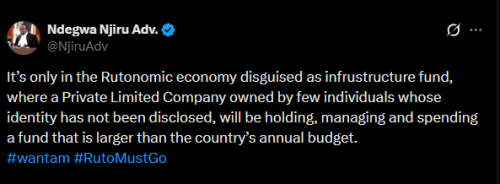
Advocate Ndegwa Njiru has raised serious concerns over the legitimacy of the National Infrastructure Fund (NIF), a flagship initiative being championed by President William Ruto.
In a statement shared on Wednesday, December 17, 2025, Njiru referred to the fund as a product of “Rutonomics”, criticising its structure and management. According to the advocate, the initiative appears more like an economic experiment benefiting a few private individuals rather than a transparent national project.
He went ahead to question how a fund of such magnitude, which is more than the country’s annual budget, could be left in the hands of private individuals
“It’s only in the Rutonomic economy disguised as an infrastructure fund, where a Private Limited Company owned by few individuals whose identity has not been disclosed, will be holding, managing and spending a fund that is larger than the country’s annual budget.”
You Might Also Like


This comes days after the fund was approved by the Cabinet on Monday, December 15, 2025. The fund, which will be financed by proceeds from privatised state assets, will also receive contributions from investors.
A portion of it will be allocated to the Sovereign Wealth Fund (SWF), which will serve as a reserve for future generations to benefit from the proceeds of the sale of strategic national assets.
This comes after Ruto stated that NIF will help the country raise funds from its budget.
NIF purpose
The president believes the NIF is a step toward moving the country to first-world status, similar to Singapore. He clarified that the private limited liability company that will manage the NIF will have its officials competitively selected.

Finance Cabinet Secretary John Mbadi also addressed the NIF fund, which has sparked significant debate, stating that the fund will not be diverted to other functions, such as debt payment, but will instead be used for commercial infrastructure projects—work that would otherwise have been financed through borrowed funds.
“It is not going to be spent on anything else, apart from infrastructure development, and not just commercially viable public infrastructure projects; that is the bottom line,” Mbadi stated.
He further stated that the fund will only be redirected in the future if it accumulates beyond the expected levels, and only then could it be used for other purposes.
Author
Latest News







Advertisement
More on News