Advertisement
More women use modern contraceptives as adolescent births decline globally – Report
Sunday 24th August, 2025 09:34 AM|
A new United Nations report has revealed significant progress in global reproductive health, showing more women are using modern contraceptives while adolescent birth rates continue to decline.
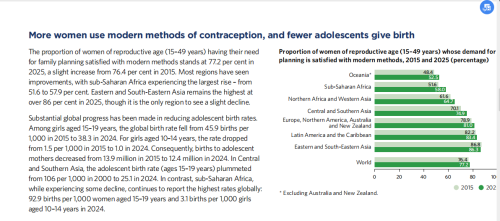
According to the findings, the proportion of women of reproductive age (15–49 years) whose family planning needs are met with modern methods has increased from 76.4 per cent in 2015 to 77.2 per cent in 2025.
Sub-Saharan Africa recorded the most substantial growth, with contraceptive use rising from 51.6 to 57.9 per cent, while Eastern and South-Eastern Asia remained the global leader at over 86 per cent, despite experiencing a slight drop.
The UN report underscored that improved access to family planning has empowered women to make informed reproductive choices, leading to healthier families and stronger communities.
You Might Also Like


“The proportion of women of reproductive age (15–49 years) having their need for family planning satisfied with modern methods stands at 77.2 per cent in 2025, a slight increase from 76.4 per cent in 2015,” read the UN report.
Decline in adolescent birth rates
The report highlighted a notable global reduction in adolescent birth rates. Among girls aged 15–19 years, the birth rate fell from 45.9 per 1,000 in 2015 to 38.3 in 2024. For girls aged 10–14, the figure dropped from 1.5 to 1.0 per 1,000. This decline translates to a reduction in births to adolescent mothers from 13.9 million in 2015 to 12.4 million in 2024.
Central and Southern Asia recorded the sharpest decrease, with rates falling from 106 per 1,000 in 2000 to 25.1 per 1,000 in 2024. However, sub-Saharan Africa remains a concern, with adolescent birth rates among the highest globally at 92.9 per 1,000 for girls aged 15–19 and 3.1 per 1,000 for those aged 10–14 in 2024.
Kenya’s persistent challenges
Despite global gains, Kenya continues to grapple with reproductive health challenges. A 2023 study by the African Population and Health Research Centre (APHRC) revealed over 1.4 million unintended pregnancies in the country. Alarmingly, 35 per cent of women who used emergency contraceptive pills still conceived, raising questions about quality and effectiveness.
Senator Hamida Kibwana called for urgent interventions to safeguard women and girls. “Protecting the reproductive rights and health of women and girls is not optional; it is a national imperative,” she said, urging improvements in post-abortion care, training of health workers, and better contraceptive supply chains.
Senator Catherine Mumma raised concerns about adolescents’ vulnerability, noting that “150 girls aged 10 to 14 years” were among those who became pregnant, and stressed the importance of comprehensive sex education.
Narok Senator Ledama ole Kina linked high abortion rates to poverty, especially in informal settlements, pointing to systemic failures that expose young girls to exploitation and stigma.
While the UN report shows progress in contraceptive use and teenage pregnancy reduction, experts warn that without addressing socio-economic inequalities and strengthening health systems, the gains could stall.
Author
Latest News







Advertisement
More on News