Key measures to take to prevent spread of Ebola virus
By Cynthia Lodite, May 24, 2026The Ministry of Health has intensified surveillance, border screening, and public awareness campaigns following the declaration of a Public Health Emergency of International Concern (PHEIC) over the ongoing Ebola outbreak in the Democratic Republic of Congo (DRC) and Uganda.
In a statement by the Health Cabinet Secretary Aden Duale, on Saturday, May 23, 2026, the ministry issued a public advisory emphasising awareness, prevention, and responsible action amid the regional threat.
If you live in or are travelling to regions where Ebola disease has been diagnosed or is suspected, take steps to protect yourself.
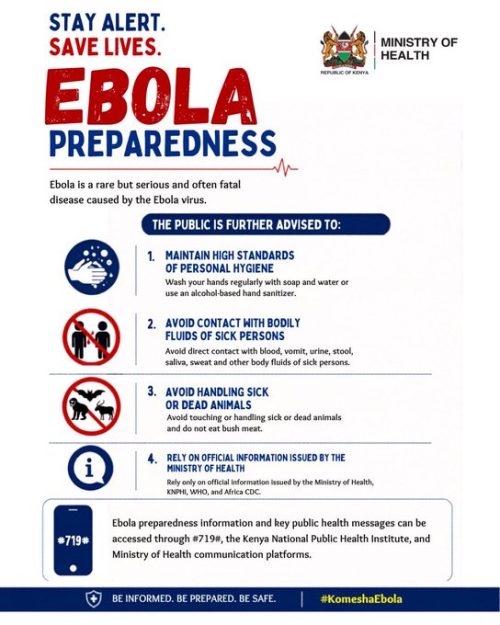
Avoid contact with body fluids
Avoid contact with body fluids, including blood, urine, faeces, saliva, sweat, vomit, breast milk, amniotic fluid, semen, and vaginal fluid from people who are sick
Also among the fluids is Semen from someone who has recovered from Ebola disease, until testing shows that the virus is no longer in the semen
At the same time, members of the public are advised to avoid contact with clothes, bedding, needles, medical equipment, or other items that may have touched an infected person’s blood or body fluids
In addition, the body of someone who is suspected or confirmed to have had Ebola disease (for instance, as part of a funeral or burial practices)
Similarly, members of the public are asked to avoid touching or handling sick or dead animals like bats, forest antelopes, primates, and blood, fluids, or raw meat from these or unknown animals
Wear personal protective equipment
Wear personal protective equipment if you come in contact with people who are sick or have died from Ebola disease, their blood and body fluids, or objects covered with their blood or body fluids.
Common symptoms
According to the Ministry of Health, the common symptoms include fever, severe weakness or fatigue, and headache with muscle pain.
At the same time, the Ministry of Health warns that vomiting and diarrhoea, as well as stomach pains, are part of the common symptoms.
In addition, MoH noted that unexplained bleeding or bruising may occur in severe cases.
Despite a perception that bleeding is a common symptom, this is less frequent and can occur later in the disease. Some patients may develop internal and external bleeding, including blood in vomit and faeces, bleeding from the nose, gums and vagina.
Bleeding at the sites where needles have punctured the skin can also occur. The impact on the central nervous system can result in confusion, irritability and aggression.