Advertisement
Kenya rolls out new malaria treatment strategy to curb drug resistance
Tuesday 28th April, 2026 12:07 PM|

The government is taking a proactive approach to malaria management with the rollout of Multiple First-Line Therapies (MFT), a new strategy aimed at enhancing the effectiveness of treatment, delaying the development of drug-resistant malaria strains, and ultimately promoting better health outcomes.
Taking it to her X handle on Tuesday, April 28, 2026, Principal Secretary (PS) for Public Health and Professional Standards in the Ministry of Health, Mary Muthoni, said that the strategy was featured at a conference on building human research capacity for malaria elimination in Africa.
”Kenya is strengthening its approach to malaria control through the introduction of Multiple First-Line Therapies (MFT), a strategic shift aimed at preserving the effectiveness of antimalarial medicines, slowing the emergence of drug resistance and improving long-term treatment outcomes,” Muthoni’s statement read.
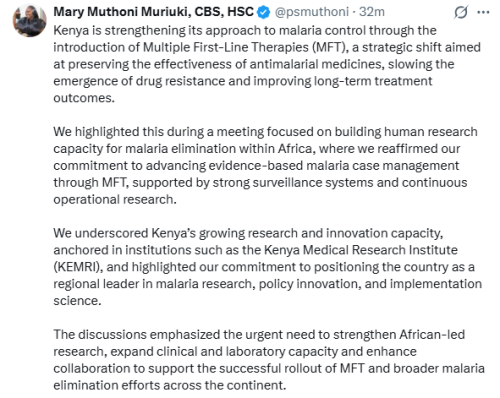
Muthoni added that Kenya reiterated its commitment to evidence-informed policymaking, highlighting that the introduction of MFT will be accompanied by improved surveillance and ongoing operational research to track its impact and inform policy changes.
You Might Also Like



The PS further stated that this strategy represents a significant shift in malaria case management, as health practitioners and policymakers explore more robust strategies to tackle this perennial health challenge. The MFT approach seeks to minimise the reliance on a single antimalarial treatment, which has led to drug resistance in many places.
Call for research and innovation
A key component of this approach is the enhancement of local research and innovation capabilities, especially within bodies like the Kenya Medical Research Institute (KEMRI). Kenya has placed KEMRI and other research institutions at the forefront of its malaria control approach, highlighting their capacity to provide data and drive innovation, as well as their influence in national and regional policy development.

The Multiple First-Line Therapies strategy adopted in Kenya is part of a trend towards flexible, evidence-based health policies and interventions to ensure sustained success in malaria control. It is also viewed as a step towards the country’s goal of becoming a hub for malaria research, policy and implementation science.
With malaria remaining a major health burden in Africa, Kenya’s move is a pre-emptive step to combat the effects of drug resistance and to build on the scientific capacity for malaria control.
Author
Latest News








Advertisement
More on News