Advertisement
County officials lead in press freedom violations as attacks on journalists rise – report
Monday 04th May, 2026 05:29 PM|

County government officials have emerged as the leading violators of press freedom in Kenya, signalling a troubling shift in power abuse from the national level to devolved units, a new report by the Media Council of Kenya (MCK) has revealed.
According to the State of Media Freedom in Kenya 2026 report, released on Monday, May 4, 2026, county officials accounted for 49 per cent of all reported attacks on journalists in 2025, marking a sharp rise from just 11 per cent the previous year.
This positions devolved administrations as the single biggest threat to media freedom in the country today.
The findings point to what the report describes as a decentralisation of impunity, where violations against journalists are increasingly perpetrated outside national institutions and within county structures.
You Might Also Like


“This State of Press Freedom report documents a complex landscape of progress and persistent challenges, county government officials emerged as the leading perpetrators (49% of cases), signalling a decentralisation of impunity even as national regulatory clarity improves,” the report states.
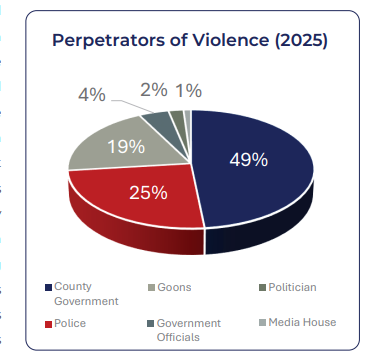
The shift comes even as police involvement in press violations declined from 29 per cent in 2024 to 25 per cent in 2025, suggesting a redistribution rather than a reduction of threats facing journalists.
Non-state actors, including politically affiliated goons, accounted for 19 per cent of incidents, underscoring the persistence of violence and intimidation in the media space.
MCK says the trend reflects the unintended consequences of devolution, where localised political power is increasingly exercised with minimal oversight, exposing journalists to heightened risks while covering county-level governance, procurement, and political activity.
The report reveals that physical assault remains the most common form of violation, accounting for 67 per cent of cases, followed by intimidation and threats at 11 per cent each. These attacks often occur during public events, political gatherings, and protests, where journalists are targeted by both state and non-state actors.
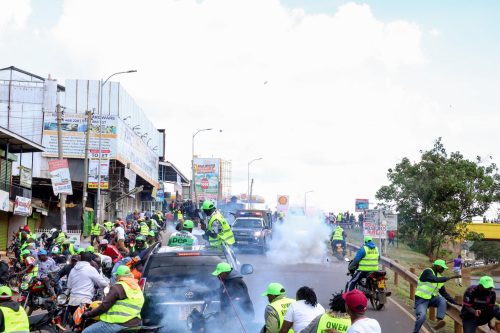
Are journalists safe?
In several documented incidents, journalists covering county functions were assaulted, denied access, or had their equipment destroyed.
The report notes that even accredited journalists with valid press credentials were not spared, highlighting systemic disregard for media rights at the devolved level.
Beyond physical attacks, the report also flags a broader climate of hostility and intimidation, warning that such actions are eroding the ability of journalists to operate freely and hold leaders accountable.
“Both state and non-state actors continue to engage in actions that restrict media operations, with assault, threats, and intimidation emerging as the most pervasive forms of violations,” the report notes.
The rise of county-level violations comes against a backdrop of wider pressures on the media industry, including economic strain, layoffs, and legal intimidation.

MCK warns that the combination of financial vulnerability and physical risk could further weaken investigative journalism, particularly in rural and semi-urban areas where county governments wield significant influence.
Nairobi remains the epicentre of press violations, accounting for 45 per cent of reported cases, but emerging hotspots such as Homa Bay and Nakuru indicate that the problem is spreading geographically.
Despite a drop in overall violations from 130 cases in 2024 to 92 in 2025, the report cautions that the nature of threats has evolved rather than diminished.
MCK is now calling for stronger accountability mechanisms at the county level, alongside enhanced protections for journalists operating in devolved units.
The findings raise urgent questions about governance and transparency in Kenya’s devolved system, as the very institutions meant to bring services closer to the people increasingly come under scrutiny for undermining one of democracy’s key pillars, a free and independent press.
Author
Latest News








Advertisement
More on News