Advertisement
How Kenya became top global player in stablecoin use
Monday 15th December, 2025 03:48 PM|

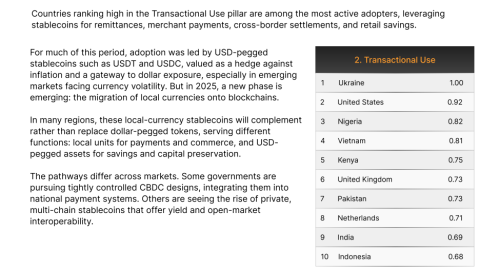
Kenya now ranks fifth in the world for stablecoin transactional use, outpacing major economies such as the United Kingdom, India and Indonesia. This is not about speculation or quick gains; stablecoins are being used in everyday finance, cross‑border payments, remittances and business transactions.
According to the 2025 World Crypto Rankings, Kenya stands just behind Ukraine, the United States, Nigeria and Vietnam on stablecoin transactional volume, a measure of real activity on blockchain networks using stablecoins like USDT and USDC.
In the 12 months to June 2024, Kenyans sent and received about Ksh426.4 billion, roughly $3.3 billion, in stablecoin transactions, tracked by blockchain analytics firm Chainalysis.
This figure makes Kenya the fourth‑largest recipient of stablecoins in Africa, behind Nigeria, South Africa and Ghana, and reflects both retail and business‑level use.
You Might Also Like



Globally, stablecoin transaction volumes hit all‑time highs in 2025, with dollar‑pegged tokens dominating the flows. They are widely used in emerging markets as a hedge against currency volatility and a low‑cost way to move value across borders.
Why stablecoins matter in Kenya
Stablecoins are digital tokens pegged 1:1 to traditional currencies, most commonly the US dollar. They let users send and receive value on blockchains with near‑instant settlement and lower fees than traditional remittances or bank transfers.
For many Kenyans, this solves real problems:
Remittances: Kenyans living abroad are increasingly using stablecoins to send money home, bypassing the high fees charged by traditional remittance services. In November 2025, Prime Cabinet Secretary Musalia Mudavadi reported that over Ksh1 trillion had been sent home by the diaspora so far this year.
Cross‑border trade: Small and medium exporters use stablecoins to pay suppliers abroad, bypassing correspondent banking delays and costs.
Daily transfers: Some local platforms allow stablecoins to be converted quickly into M‑Pesa and other mobile money wallets, making it simple for users to cash out.
A recent Yellow Card report estimated that stablecoins accounted for 43 per cent of all crypto transactions in sub‑Saharan Africa, with Kenya emerging alongside Nigeria, South Africa and Ghana as one of the region’s fastest‑growing markets.
Peter Mwangi, Yellow Card’s Country Manager for Kenya, says the adoption trend has clear roots in existing digital behaviour:
“Kenya’s strong mobile money ecosystem, especially M-Pesa, allows for seamless stablecoin integration. A tech-savvy youth population is also turning to stablecoins for cheaper remittances and protection against currency swings, making them practical financial tools,” he explained.

What drives adoption
Several factors have pushed Kenya up the rankings.
1. Mobile money culture: Kenya already has one of the highest mobile money penetration rates in Africa. Stablecoins slot into this ecosystem by allowing blockchain‑based value to be converted into mobile money almost instantly.
2. Cost and speed advantage: Stablecoin transfers can cost 0.5–1 per cent of the value sent, compared with 4–7 per cent or more for traditional remittance channels. Settlement typically completes in minutes.
3. Economic pressures: Kenya’s inflation and currency fluctuations have encouraged users to hold some savings or transact in dollar‑linked assets such as USDT and USDC, which are less exposed to shilling volatility.
4. Business use cases: Multinationals and local firms use stablecoins for import payments, payroll and repatriation of profits, bypassing slow and costly bank processes.
Regulation is catching up
Until recently, Kenya lacked clear rules for stablecoins and crypto platforms. This uncertainty limited institutional participation and kept the country’s institutional readiness score lower than its transactional score.
However, the Virtual Asset Service Providers (VASP) Act, 2025, passed by Parliament, is set to change that by regulating stablecoin and crypto firms. The law assigns the Central Bank of Kenya (CBK) to oversee licences for stablecoin issuers and the Capital Markets Authority (CMA) to license exchanges and trading platforms.
Regulators hope this clarity will attract investment, improve consumer protection and make it easier for businesses to adopt digital assets with confidence. Bybit, the exchange behind the 2025 ranking, notes that clear regulation could even allow crypto payroll systems to operate legally in Kenya.
With clearer regulation now coming into force, Kenya could harness this momentum to become a regional hub for regulated digital payments and stablecoin‑based financial products. This would help local businesses, reduce remittance costs, and offer new ways for savings and trade in a world where digital assets play a growing role.
Author
Kenneth Mwenda
Kenneth Mwenda is a business, sports, and politics digital writer with over seven years of experience in journalism, covering breaking news, feature stories, and in-depth analysis across a range of beats.
For inquiries, he can be reached at [email protected]
View all posts by Kenneth MwendaLatest News








Advertisement
More on Insights