Advertisement
Explainer: How US withdrawal from WHO could affect global health
Tuesday 27th January, 2026 06:25 AM|

The decision by the United States to withdraw from the World Health Organisation (WHO) during President Donald Trump’s second term has sent shockwaves through the global health community.
While the move is political, its consequences are deeply practical, especially for poorer regions of the world. Africa, which relies heavily on external health funding, is likely to feel the impact most sharply.
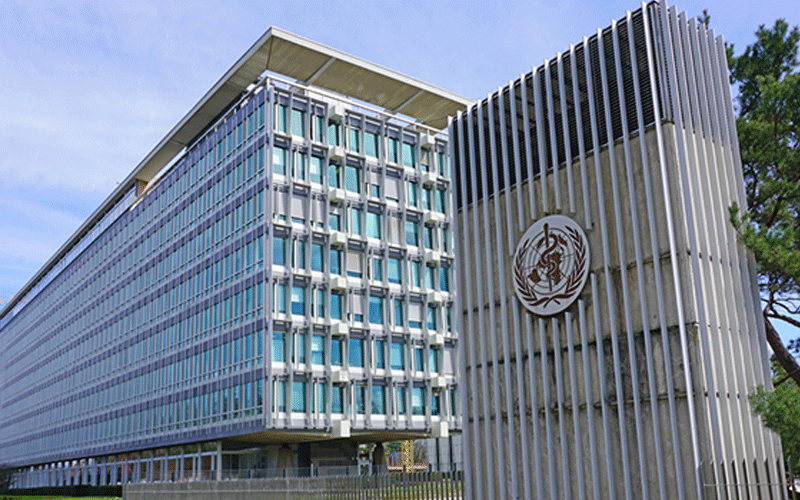
The United States has long been the WHO’s single largest donor. In recent years, it contributed about 12 to 15 per cent of the agency’s total budget.
That money helps keep essential health programs running, from disease surveillance and vaccination campaigns to maternal health and emergency response. When such a major funding pillar is removed, the effects ripple far beyond the WHO headquarters in Geneva.
You Might Also Like
At the global level, the immediate concern is a funding gap. WHO uses US contributions to support programs targeting HIV/AIDS, tuberculosis, malaria, maternal and child health, and outbreak preparedness.
These are not abstract priorities; they translate into medicines, vaccines, training for health workers, and support for fragile health systems. Without US funding, the WHO will be forced to scale back or delay some of these activities unless other donors step in quickly.
Africa is particularly exposed because many countries on the continent depend on external financing for a large share of their health budgets. In several low- and middle-income countries, donor funding supports everything from free HIV treatment to mosquito control programs.
If WHO-backed programs shrink, governments may struggle to fill the gap, especially those already facing debt, inflation, or political instability.

Individual health burden
The likely result is reduced access to essential services. HIV prevention programs could slow, tuberculosis detection rates may fall, and malaria control efforts could weaken.
Maternal and child health services, such as antenatal care, safe delivery programs, and childhood immunisation, are also at risk. These setbacks could reverse years of hard-won progress and lead to preventable deaths.
Another major consequence is the growing burden on households. When public health programs lose funding, costs are often pushed onto individuals.
In Africa, out-of-pocket spending is already one of the main ways people pay for healthcare. Any reduction in subsidised services means families must pay more for medicines, tests, or preventive tools.
For poor households, this can mean delaying care or skipping treatment altogether. Early signs of this trend are already emerging, with prices of some health commodities rising amid fears of reduced donor support.
The withdrawal also weakens global health coordination. WHO plays a central role in tracking disease outbreaks, setting health standards, and coordinating responses during emergencies. Reduced funding limits its ability to act quickly and effectively.
In a world still recovering from COVID-19 and facing threats like Ebola, mpox, and new pandemics, this loss of capacity affects everyone, not just Africa.
However, the crisis may also force difficult but necessary conversations. For African governments, it highlights the risks of overreliance on external donors.
Meanwhile, the shock could push countries to strengthen domestic health financing, expand national health insurance schemes, and invest more in local pharmaceutical production. If managed well, this could improve long-term sustainability.
Still, such transitions take time. In the short term, the US withdrawal from the WHO is likely to deepen existing health inequalities. Countries with weak health systems will suffer most, while progress toward universal health coverage may slow or stall.
Author
Latest News

Advertisement
More on Insights