Advertisement
Global AI trade boom opens new export frontier for Kenya’s digital economy – UN
Sunday 26th July, 2026 12:55 AM|

Kenya may not yet manufacture semiconductors or electric vehicle batteries. However, a new United Nations trade report suggests the country could still emerge as one of Africa’s biggest beneficiaries of the global artificial intelligence (AI) boom through exports of digital services, software, fintech and cloud-based solutions.
According to the latest UN Trade and Development (UNCTAD) Global Trade Update (July–August 2026), AI-related industries are now among the fastest-growing sectors in global commerce. The report says trade in critical minerals expanded by 38 per cent during the first quarter of 2026, while semiconductors grew by 25 per cent, electronics by 18 per cent, ICT products by 14 per cent, batteries by 15 per cent and electric vehicles by 11 per cent.
The report notes that “AI- and electric vehicle-related goods showed strong growth in Q1-2026,” underlining how artificial intelligence is reshaping global trade patterns.
While Kenya has no significant semiconductor manufacturing industry, analysts say the country’s comparative advantage lies elsewhere, in exporting digital expertise rather than physical AI hardware.
You Might Also Like



Nairobi has increasingly positioned itself as East Africa’s technology capital, supported by a vibrant startup ecosystem, fintech innovation, business process outsourcing (BPO), cloud computing services and software engineering talent serving international markets.
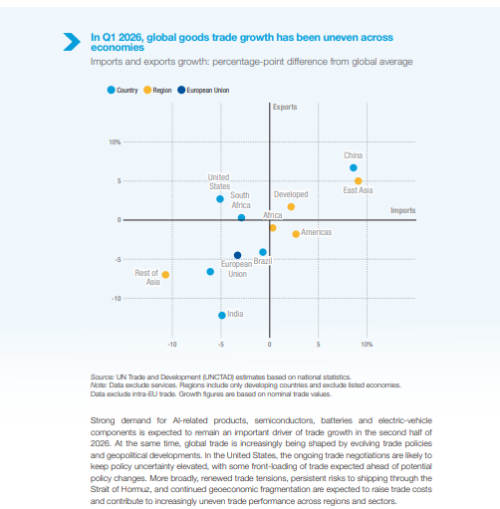
UNCTAD observes that “rapid expansion in digital technologies, artificial intelligence (AI), and green industries continues to create new sources of global trade and investment.” It adds that demand for “AI infrastructure, cloud computing, digitally delivered services” is accelerating innovation and supporting trade in high-value services.
That assessment aligns closely with Kenya’s ambitions under its digital economy strategy, where exports increasingly include software development, remote technology services, cybersecurity, artificial intelligence applications and digital financial solutions.
The report further projects that “strong demand for AI-related products, semiconductors, batteries and electric-vehicle components is expected to remain an important driver of trade growth in the second half of 2026.”
For Kenya, the question is whether the country can convert this expanding global demand into higher-value digital exports.
Institutions such as Konza Technopolis, the ICT Authority, Safaricom and a growing community of AI startups have spent recent years building digital infrastructure aimed at positioning Kenya as a regional innovation hub. International technology firms including Microsoft and Google have also expanded investments in AI training, cloud infrastructure and developer ecosystems across East Africa.
Although the UNCTAD report focuses primarily on manufacturing-led AI trade, its emphasis on digitally delivered services creates opportunities for economies that may not yet produce advanced hardware.

Rather than competing directly with semiconductor giants in East Asia, Kenya could strengthen exports of AI software, cloud engineering, financial technology, machine learning solutions and outsourced digital services to international clients.
The report also identifies changing global supply chains as another opportunity. It says businesses are increasingly investing in resilient supply chains while “connector economies are attracting greater investment and expanding their roles in regional and global value chains.”
That trend could favour Nairobi, whose strategic location, expanding digital infrastructure and access to the East African Community market position it as a potential gateway for technology investment into the region.
However, challenges remain. Kenya continues to rely heavily on imported advanced electronics, limited local semiconductor capability and gaps in high-end manufacturing capacity. Bridging these gaps will require sustained investment in digital skills, research, innovation financing and supportive policies that encourage technology exports.
Still, the broader direction of global trade appears clear. UNCTAD concludes that AI, cloud computing and digital technologies are creating entirely new engines of international commerce.
For Kenya, the opportunity may not lie in becoming the world’s next semiconductor manufacturer, but in becoming Africa’s leading exporter of AI-powered services. If policymakers, investors and technology firms can seize the moment, Nairobi could transform its thriving innovation ecosystem into one of East Africa’s most valuable export industries—and become a recognised digital trade powerhouse in the age of artificial intelligence.
Author
Latest News






Advertisement
More on Business