Advertisement
Lee Kinyanjui reveals why Kenya is losing billions from its tea despite global dominance
Saturday 25th July, 2026 09:02 AM|

Ministry of Investments, Trade and Industry Cabinet Secretary Lee Kinyanjui has unveiled a fresh government push to increase value addition in Kenya’s tea industry, warning that the country continues to lose billions of shillings annually by exporting almost all its tea in raw form despite dominating the global black tea market.
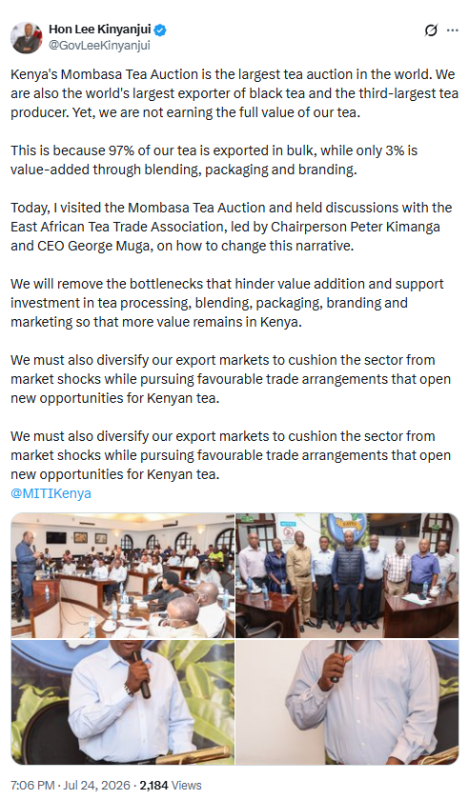
Taking to his official X account on Friday, July 24, 2026, moments after touring the Mombasa Tea Auction, the world’s largest black tea auction, the CS said Kenya earns only a fraction of the potential value of its tea because 97 per cent of exports leave the country in bulk, while only three per cent undergo processing through blending, packaging and branding.
“Kenya’s Mombasa Tea Auction is the largest tea auction in the world. We are also the world’s largest exporter of black tea and the third-largest tea producer. Yet, we are not earning the full value of our tea,” Kinyanjui wrote on X after meeting officials from the East African Tea Trade Association (EATTA) led by Chairperson Peter Kimanga and CEO George Muga.
Billions lost through bulk exports
The Cabinet Secretary said the government intends to reverse decades of dependence on bulk tea exports by encouraging greater investment in local tea processing and branding.
You Might Also Like



According to Kinyanjui, increasing value addition would allow Kenya to capture more income across the tea value chain while creating additional jobs in manufacturing, logistics and marketing.
“We will remove the bottlenecks that hinder value addition and support investment in tea processing, blending, packaging, branding and marketing so that more value remains in Kenya,” he said.
He also announced plans to diversify Kenya’s export destinations to reduce dependence on a handful of traditional markets.
“We must diversify our export markets to cushion the sector from market shocks while pursuing favourable trade arrangements that open new opportunities for Kenyan tea.”
Kenya dominates global tea trade
Kenya remains the world’s largest exporter of black tea, accounting for roughly 30 per cent of global black tea exports, while the Mombasa Tea Auction serves buyers from across Africa, Asia, Europe and the Middle East.
The auction is operated by the East African Tea Trade Association and trades tea from Kenya alongside consignments from Uganda, Rwanda, Tanzania, Burundi, Malawi, Mozambique, Zimbabwe, the Democratic Republic of Congo and Madagascar.
Tea remains one of Kenya’s biggest foreign exchange earners, supporting millions of livelihoods through farming, processing, transport and export.
However, industry players have long argued that Kenya exports too much of its tea as an unbranded commodity, allowing overseas companies to reap higher profits by packaging and selling Kenyan tea under foreign brands.
Sector under pressure
Kinyanjui’s remarks come at a time when Kenya’s tea industry is facing fresh market challenges despite relatively stable auction prices.
In June, the Mombasa Tea Auction recorded its highest volume of unsold tea this year, with exporters blaming increased costs arising from the new export levy and disruptions to global shipping linked to instability in the Red Sea.
Although the Tea Board of Kenya recently reported stronger auction performance in June, with farmers earning approximately Ksh13 billion after 46.52 million kilogrammes of tea were traded, officials acknowledged that Kenya remains heavily dependent on a small number of export destinations.
Tea Board of Kenya CEO Willy Mutai recently noted that while Kenyan tea reaches more than 90 export markets, over 80 per cent of exports are concentrated in about 10 countries, leaving the industry vulnerable to geopolitical tensions, foreign exchange shortages and trade disruptions.
Push for local brands
Successive governments have attempted to encourage local tea packaging and branding, but progress has remained slow as exporters continue favouring bulk shipments, which require lower capital investment and established international distribution networks.
Industry stakeholders have argued that increasing local value addition would significantly boost export earnings without necessarily increasing tea production.
Kinyanjui said removing regulatory bottlenecks and encouraging private investment in tea processing will be central to the government’s strategy for transforming the sector.
The initiative forms part of broader efforts to industrialise Kenya’s agricultural exports by shifting from raw commodity exports towards higher-value manufactured products.
If successful, the strategy could substantially increase export earnings, strengthen the resilience of Kenya’s tea sector and improve returns for hundreds of thousands of smallholder tea farmers who currently depend largely on global auction prices for their incomes.
Author
Mustafa Juma
View all posts by Mustafa JumaLatest News







Advertisement
More on Business