Advertisement
Willis Otieno faults govt over conflicting signals in matatu strike response
Tuesday 19th May, 2026 04:06 PM|

Safina Deputy Party Leader Willis Otieno has accused the state of sending mixed signals when handling the current protest on fuel prices that he says undermine efforts to resolve the transport crisis.
In a statement on his X account on Tuesday, May 19, 2026, Otieno pointed to Interior Cabinet Secretary Kipchumba Murkomen’s announcement of a seven-day suspension of the matatu strike to allow room for negotiations with sector stakeholders, a move intended to de-escalate tensions and restore commuter services.
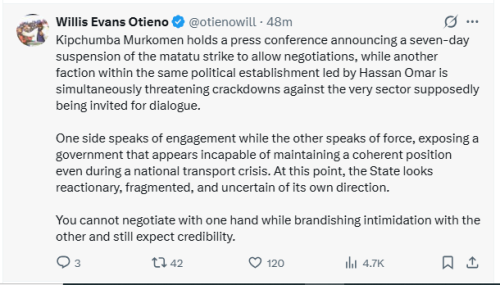
However, he contrasted this with parallel remarks attributed to a faction within the same political establishment led by former Mombasa Senator Hassan Omar, which he says has threatened enforcement crackdowns against operators in the same sector that have been invited for dialogue.
“Kipchumba Murkomen holds a press conference announcing a seven-day suspension of the matatu strike to allow negotiations, while another faction within the same political establishment led by Hassan Omar is simultaneously threatening crackdowns against the very sector supposedly being invited for dialogue,” Otieno said.
Problem within government
You Might Also Like



According to Otieno, the conflicting positions reflect a deeper problem within government communication and strategy, arguing that one arm of the State appears to be pursuing engagement while another is leaning toward coercion.
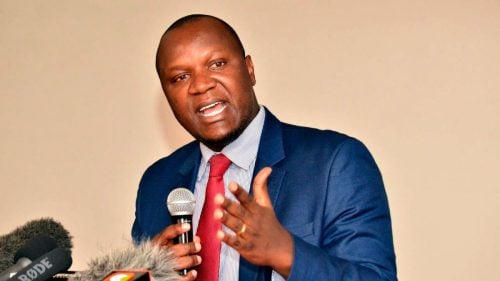
“One side speaks of engagement while the other speaks of force, exposing a government that appears incapable of maintaining a coherent position even during a national transport crisis. At this point, the State looks reactionary, fragmented, and uncertain of its own direction,” Otieno noted.
He further warned that such contradictions risk eroding public trust in the ongoing negotiations, saying it is difficult to build confidence in dialogue when enforcement threats are issued simultaneously.
“You cannot negotiate with one hand while brandishing intimidation with the other and still expect credibility,” Otieno added.
EPRA new prices
EPRA announced the revised fuel prices through a special addendum issued on the night of May 18, 2026, following mounting pressure from public transport operators and motorists over soaring fuel costs.

The new prices took effect at midnight on May 19, 2026, and are expected to remain in force until June 14, 2026.
In Nairobi, Super Petrol will retail at Ksh214.25 per litre, diesel at Ksh232.86 per litre, and kerosene at Ksh191.38 per litre.
Impact of strike
The nationwide strike began on Monday, May 18, 2026, following sharp increases in fuel prices that triggered protests from matatu operators, truck drivers, boda boda riders and other transport stakeholders.
The demonstrations paralysed transport in Nairobi and several major towns, leaving thousands of commuters stranded and forcing many Kenyans to walk long distances to work and school.
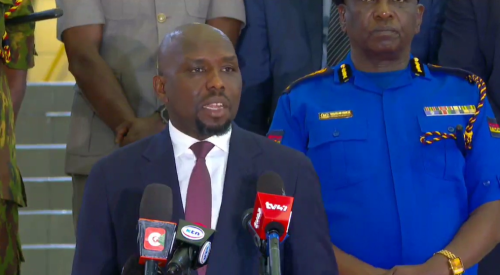
In a statement issued by the Ministry of Interior and National Administration on Tuesday, May 19, 2026, the government said both sides agreed to continue negotiations while transport operators resume services across the country.
Interior Cabinet Secretary Kipchumba Murkomen said the government understands the pressure Kenyans are facing due to the increase in global fuel prices linked to the crisis in the Middle East.
“The Government appreciates the challenges faced by Kenyans as a result of the rising global fuel prices occasioned by the Middle East crisis,” the statement read.
Author
Emmanuel Rono
Rono is a digital journalist with a proven track record in newsroom leadership and content creation. Currently a Digital Writer for People Daily Digital, Emmanuel’s career is rooted in a lifelong passion for storytelling. Let's talk here: [email protected] or [email protected]
View all posts by Emmanuel RonoLatest News





Advertisement
More on Inside Politics