Advertisement
Willis Otieno: Billions continue to evaporate as Kenyans suffer
Thursday 04th June, 2026 09:41 AM|

Lawyer Willis Otieno has intensified criticism of the government’s economic management, arguing that ordinary Kenyans continue carrying an increasingly heavy financial burden while billions are allegedly being lost through policy failures, debt obligations, and fiscal decisions.
Speaking in a statement shared on his X account on Thursday, June 4, 2026, Otieno painted a picture of what he described as an escalating economic crisis, saying the burden ultimately falls on households already struggling with high living costs and shrinking incomes.
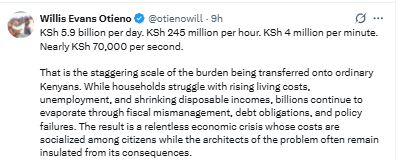
According to Otieno, the figures reflect the scale of the pressure citizens continue to absorb daily.
“Ksh5.9 billion per day. KSh 245 million per hour. Ksh 4 million per minute. Nearly KSh 70,000 per second,” he said.
Billions continue to evaporate
You Might Also Like


Otieno argued that while many Kenyans are dealing with unemployment and economic uncertainty, massive amounts of money continue disappearing through what he termed systemic failures.
“That is the staggering scale of the burden being transferred onto ordinary Kenyans,” Otieno stated.
“While households struggle with rising living costs, unemployment and shrinking disposable incomes, billions continue to evaporate through fiscal mismanagement, debt obligations and policy failures,” he added.
He further claimed that the costs of economic challenges are increasingly being pushed onto citizens while those responsible remain protected from the consequences.
Finance Bill debate returns to centre stage
His remarks come amid renewed political debate surrounding the proposed Finance Bill 2026, with leaders questioning the government’s fiscal direction and spending priorities.

People’s Liberation Party leader Martha Karua recently criticised the bill, describing it as a continuation of measures that previously attracted widespread public resistance.
“The Finance Bill 2026/27 is a replica of the 2024 Finance Bill. It contains the same punitive measures that Kenyans rejected,” Karua said.
Questions over accountability grow
Karua also questioned the credibility of public participation, arguing that citizens were increasingly being excluded from meaningful involvement in decisions affecting taxation and spending.
“Kenyans are rarely given a genuine opportunity to participate in public participation forums,” she said.
As debate over the Finance Bill intensifies, concerns are increasingly shifting beyond taxation itself to broader questions of accountability, public expenditure and whether economic decisions are easing or increasing pressure on ordinary citizens.
Author
Latest News








Advertisement
More on Inside Politics