Advertisement
MP Makali Mulu blasts govt over delayed response to transport strike
Tuesday 19th May, 2026 08:23 AM|
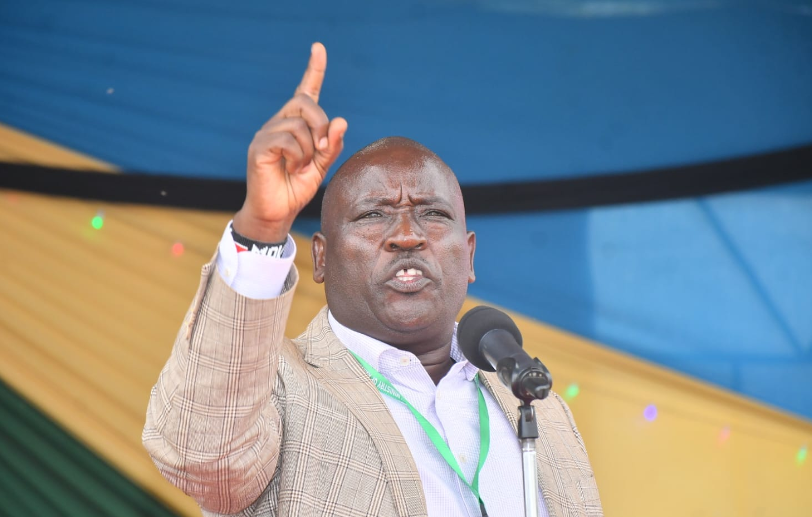
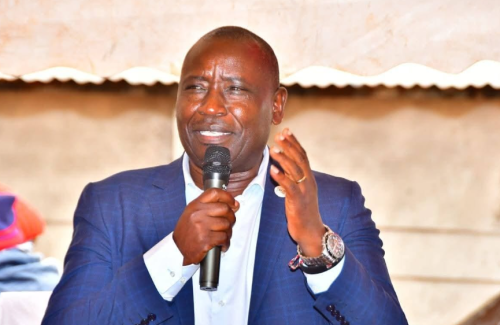
Kitui Central Member of Parliament (MP) Makali Mulu has criticised the government for what he termed as a delayed and reactive response to the ongoing transport sector strike.
Speaking during an interview with a local TV station on Tuesday, May 19, 2026, the lawmaker warned that the country is already incurring significant economic losses due to disrupted mobility and stalled economic activity.
The MP, who is an economist by training, said the nationwide strike by transport operators could have been prevented if timely consultations had been held between government officials and stakeholders in the transport and energy sectors.
Mulu said the strike has effectively slowed down key sectors of the economy, affecting transport, trade, and production across the country.
You Might Also Like
“As an economist, I got very concerned when I saw that the economy was at a standstill. I don’t know whether those concerned know about what loss we are incurring,” Mulu said.
He noted that transport disruptions have immediate ripple effects on supply chains, commodity prices, and access to essential services.
Call for proactive engagement
The MP questioned why cabinet secretaries waited until the strike had already begun before engaging transport stakeholders, arguing that early dialogue could have prevented the escalation.
He specifically pointed to the ministries of energy, treasury, and roads and transport, saying they should have convened urgent talks before the industrial action began.
“The transporters’ association had indicated that they would be on strike on Monday. Was it necessary that we have to wait up to Monday when they are already on the streets for the minister for energy, the minister for treasury, and the minister for roads and transport to summon them?” he posed.
He added that proactive engagement over the weekend could have saved the country from the disruptions witnessed during the strike.
Warning on economic impact
Mulu further warned that Kenya’s high cost of production is making the economy increasingly fragile, noting that even small increases in fuel prices can have far-reaching consequences.
“The cost of production is so high that increasing prices by a shilling is too much for Kenyans,” he said.
He emphasised that fuel prices directly affect transport costs, food prices, and overall inflation, placing additional pressure on households and businesses already struggling with the cost of living.
The MP urged government officials to adopt a more proactive approach in managing economic disputes, especially those affecting essential sectors like transport and energy.
He argued that early engagement with stakeholders could help prevent future disruptions and stabilise the economy.
As the transport strike continues to ripple across parts of the country, pressure is mounting on the government to reach a resolution with operators and introduce measures aimed at addressing fuel pricing concerns.
Chaotic press briefing
Attempts to hold talks already ended in a chaotic press briefing that exposed sharp disagreements between the government and transport sector stakeholders over the ongoing nationwide fuel strike.
The clash unfolded publicly on Monday, May 18, 2026, shortly after talks between government officials and transport operators ended without a clear consensus on fuel pricing concerns.
The tension became evident moments after Energy CS Opiyo Wandayi addressed journalists and attempted to explain the outcome of the discussions held with transport stakeholders.
However, one of the matatu sector representatives openly contradicted the Cabinet Secretary during the live briefing, insisting that no meaningful agreement had been reached.
“With all due respect, we have not agreed on anything,” the representative said angrily while addressing the media.
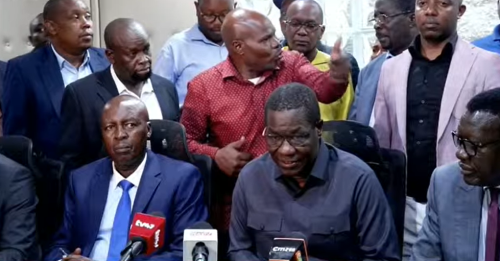
The official further accused the government of failing to address the core issue affecting transport operators and drivers, particularly the high cost of fuel.
The matatu representative claimed the government had the capacity to provide the Ksh46 relief that transport stakeholders had demanded.
“We know very well that the Ministry of Energy could do something to give us Ksh46, which they say they do not have. The government has a lot of pockets and can get this Ksh46 we are looking for,” he stated.
The remarks highlighted growing frustration within the transport sector despite government efforts to lower diesel prices through a fresh EPRA addendum announced earlier in the night.
During the same briefing, Wandayi defended the government’s approach and explained that part of the discussions focused on addressing the risk of fuel adulteration caused by the widening gap between diesel and kerosene prices.
The government later announced a reduction in diesel prices by Ksh10.06 per litre, although the move was immediately rejected by sections of the transport sector and the Motorists Association of Kenya.
Author
Mustafa Juma
View all posts by Mustafa JumaLatest News






Advertisement
More on Inside Politics