2027 Kenya Elections: How rising security fears put Ruto’s re-election bid under spotlight
By Aloys Michael, June 20, 2026President William Ruto is heading into what could become the most consequential political test of his presidency as fresh warnings over electoral vulnerabilities, rising political violence and growing demands for constitutional reforms converge ahead of the 2027 General Election.
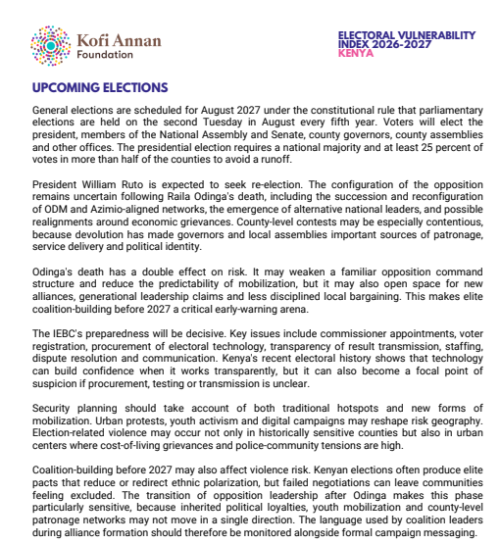
A new Electoral Vulnerability Index (EVI) 2026-2027 report by the Kofi Annan Foundation reveals that Kenya has stronger institutions than many of its regional peers, but one that remains highly susceptible to election-related tensions.
The report assigns Kenya an Electoral Vulnerability Index score of 45.4 and projects an 84.1 per cent probability of some form of electoral violence during the 2027 polls, underscoring the fragile environment in which the next election will be conducted.
The warning comes as a new constitutional push by civil society group Kuna Dawa seeks to temporarily strip the sitting president of executive authority during election periods, transferring power to the Chief Justice until a president-elect is sworn in.
The proposal, though controversial, reflects growing concerns among sections of civil society and the opposition over the concentration of executive power during elections.
It also emerges against the backdrop of an increasingly troubling pattern of politically charged disruptions and public disorder, including attacks on churches from the violence witnessed in Witima to the recent invasion of Nairobi’s All Saints Cathedral by suspected goons.
The EVI report warns that election-related risks are no longer confined to traditional political battlegrounds. Instead, it notes that urban protests, youth activism and digital mobilisation are reshaping Kenya’s electoral risk landscape.
“Security planning should take account of both traditional hotspots and new forms of mobilisation. Urban protests, youth activism and digital campaigns may reshape risk geography,” the report states.
It adds that violence may occur not only in historically volatile counties but also in urban centres where economic frustrations and tensions between communities and security agencies remain high.
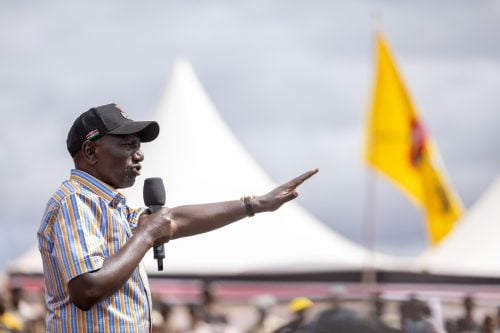
Security concerns
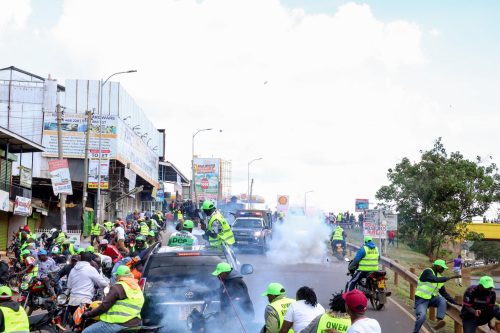
Those concerns resonate with recent events. Kenya has witnessed growing accusations of organised groups disrupting public gatherings, opposition events and even places of worship. The phenomenon has fuelled fears that political competition ahead of 2027 could increasingly spill into non-traditional civic spaces.
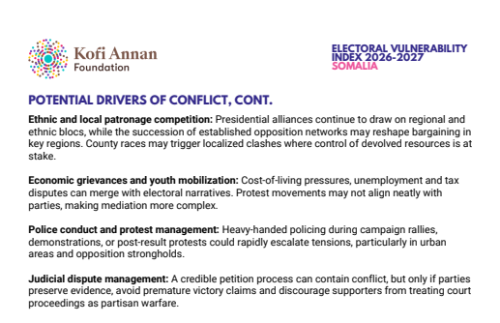
The report identifies police conduct and protest management as one of the key triggers that could escalate tensions.
“Heavy-handed policing during campaign rallies, demonstrations, or post-result protests could rapidly escalate tensions, particularly in urban areas and opposition strongholds,” it warns.
At the same time, Ruto’s administration has unveiled a budget that signals where government priorities lie as the country gradually enters election mode.
Despite pressure to cut spending, the government has channelled substantial resources toward security agencies and electoral preparations. The Ministry of Defence emerged as the single largest beneficiary among ministries, receiving Ksh252.1 billion alongside additional funding for defence operations and industrialisation programmes.
The Independent Electoral and Boundaries Commission (IEBC), whose commissioners are already in office, is also expected to receive enhanced support as preparations for the 2027 election gather pace.
Parliament’s Budget and Appropriations Committee has already stressed the importance of early financing for the electoral body.
“There is a need for timely funding of the commission to avoid the last-minute financing challenges that have characterised previous election cycles and to ensure adequate preparation for the 2027 polls,” the committee observed.
Yet even with commissioners in place, election management remains under scrutiny.
Opposition leaders have raised questions over the audit of KIEMS kits, the voter register and Smartmatic contracts that expired in May 2026. The concerns mirror one of the EVI report’s strongest warnings, that confidence in electoral technology and administration could become a flashpoint.
“The IEBC’s preparedness will be decisive. Commissioner appointments, voter registration, electoral technology procurement, results transmission and dispute resolution are critical areas requiring transparency. It warns that technology can either build confidence or become a focal point of suspicion if procurement and transmission processes are unclear,” the report study observes.

Ruto’s acid test
That context helps explain why proposals to limit presidential authority during election periods are gaining traction.
“Upon the official commencement of the presidential election campaign period as declared by the Independent Electoral and Boundaries Commission, the sitting President shall temporarily vacate the executive authority of the office,” the draft reads.
Supporters argue that the proposal would shield elections from executive influence and strengthen public trust in the outcome. Critics, however, contend that it is constitutionally impractical and risks creating governance uncertainty during a politically sensitive period.
Beyond the presidency, the draft proposes far-reaching reforms, including reducing Parliament’s size, restructuring representation and devolving security coordination to county governments.
Whether or not those proposals succeed, they reveal a broader national debate over how to guarantee electoral credibility in a highly competitive political environment.
The Kofi Annan Foundation report says that Kenya’s institutions remain stronger than those of many countries facing election risks, but warns that public trust is the decisive factor.
“Kenya’s institutions are stronger than many high-risk cases, but expectations are also higher. If institutions are perceived as captured, inconsistent or unprepared, public reaction can be sharp.”
For Ruto, that may be the defining challenge of 2027, as beyond securing re-election, he will have to convince Kenyans that the institutions overseeing the vote are independent, credible and capable of resisting political interference.
In an era of economic frustrations, youth mobilisation and growing concerns over security, the battle for public confidence may prove just as important as the battle for votes as the opposition vows to make Ruto a one- term president.