Advertisement
Treasury says ongoing customs clearance reforms are enhancing Kenya’s competitiveness as a trade hub
Wednesday 24th December, 2025 11:57 AM|

The National Treasury has announced that ongoing customs clearance reforms are reducing border delays and strengthening Kenya’s position as a regional trade hub while potentially lowering consumer prices.
In a statement posted on its official X account on Wednesday, December 24, 2025, the Treasury highlighted how faster customs clearance processes directly impact the cost of goods, supply availability, and the overall business environment in Kenya.
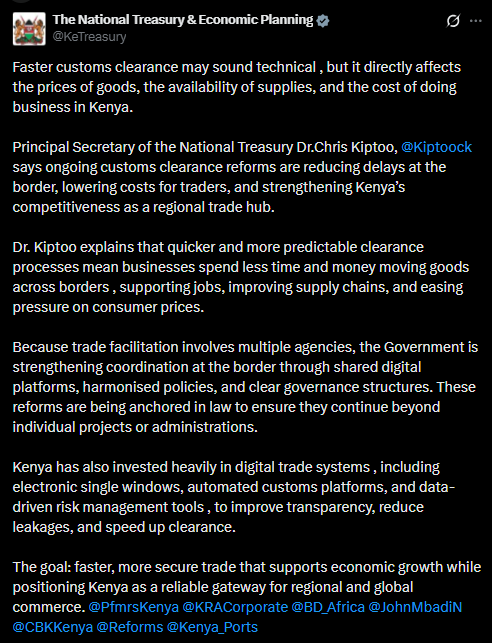
“Faster customs clearance may sound technical, but it directly affects the prices of goods, the availability of supplies, and the cost of doing business in Kenya,” the statement read.
Reducing costs and delays
According to the statement, Principal Secretary for the National Treasury Dr Chris Kiptoo, explained that the reforms are delivering tangible benefits for traders and businesses operating across Kenya’s borders.
You Might Also Like



Kiptoo said the ongoing customs clearance reforms are “reducing delays at the border, lowering costs for traders, and strengthening Kenya’s competitiveness as a regional trade hub.”
The PS emphasised that quicker and more predictable clearance processes translate into reduced time and money spent by businesses moving goods across borders.
“Dr Kiptoo explains that quicker and more predictable clearance processes mean businesses spend less time and money moving goods across borders, supporting jobs, improving supply chains, and easing pressure on consumer prices,” the Treasury stated.
Multi-agency coordination
The Treasury further acknowledged that effective trade facilitation requires coordination among multiple agencies at border points.
To address this challenge, the Treasury said the government is strengthening coordination at the border through shared digital platforms, harmonised policies, and clear governance structures.
“Because trade facilitation involves multiple agencies, the Government is strengthening coordination at the border through shared digital platforms, harmonised policies, and clear governance structures. These reforms are being anchored in law to ensure they continue beyond individual projects or administrations,” the Treasury explained.

Digital transformation
As part of the customs modernisation drive, the Treasury revealed that Kenya has made significant investments in digital trade systems.
These investments include electronic single windows, automated customs platforms, and data-driven risk management tools designed to improve transparency, reduce revenue leakages, and accelerate clearance processes.
“Kenya has also invested heavily in digital trade systems, including electronic single windows, automated customs platforms, and data-driven risk management tools, to improve transparency, reduce leakages, and speed up clearance,” the statement said.
Regional gateway ambitions
The Treasury outlined the government’s broader ambition to position Kenya as a reliable gateway for regional and global commerce.
The ultimate goal of these reforms is to achieve faster and more secure trade that supports economic growth while enhancing Kenya’s competitive advantage in the region.
“The goal: faster, more secure trade that supports economic growth while positioning Kenya as a reliable gateway for regional and global commerce,” the Treasury concluded.
Author
Cy Muganda
View all posts by Cy MugandaLatest News








Advertisement
More on Business