Advertisement
Motorists push for fuel relief ahead of EPRA price review
Tuesday 14th April, 2026 03:15 PM|

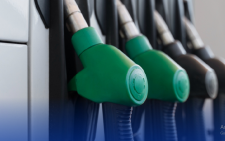
The Motorists Association of Kenya (MAK) has urged the government to act ahead of the latest fuel price review by the Energy and Petroleum Regulatory Authority (EPRA), warning that high pump prices continue to strain households and businesses.
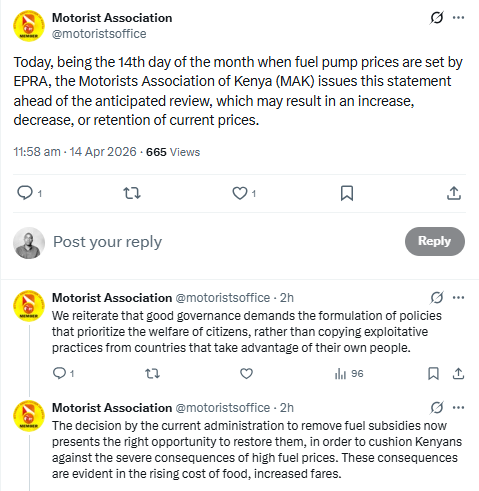
In a statement released on April 14, 2026, the association said the monthly review could result in “an increase, decrease, or retention of current prices” but insisted that policy decisions must focus on easing the burden on Kenyans.
“We reiterate that good governance demands the formulation of policies that prioritise the welfare of citizens, rather than copying exploitative practices from countries that take advantage of their own people,” MAK said.
The group called for the return of fuel subsidies, arguing that their removal has exposed consumers to rising costs across the economy. It linked high fuel prices to increases in food costs and transport fares, saying the effects are already visible.

You Might Also Like

“The decision by the current administration to remove fuel subsidies now presents the right opportunity to restore them, in order to cushion Kenyans against the severe consequences of high fuel prices,” the statement read.
Faults recent changes affecting energy sector
MAK also criticised tax changes introduced in recent years. It said the government increased VAT on fuel by eight per cent, removed the fuel subsidy stabilisation fund, and raised the Road Maintenance Levy Fund by Ksh7 per litre. According to the association, reversing these measures would significantly reduce pump prices.
“Reversing these three measures would significantly lower pump prices,” it said.
The association further argued that the government has collected large revenues from fuel over the past three years, especially during periods of lower global prices. It claimed these gains have not been passed on to consumers.
“This is especially justified given that over the past three years, the government has collected substantial windfall revenues from fuel amid lower global prices – benefits that have never been passed on to consumers,” MAK argued.
At the same time, it dismissed ongoing claims about illegal fuel shipments and diversions as a distraction. The group said such narratives, including the sacking of officials without prosecutions, mislead the public.
“The continued narrative of alleged illegal fuel shipments, diversion claims, and the publicised sacking of officials, without any prosecutions, is a diversionary tactic aimed at misleading the public while exploitation persists,” it said, adding that such actions “amount to economic offences against Kenyans.”
MAK warned that high fuel prices are worsening the cost-of-living crisis and hurting economic activity. It said businesses are struggling to stay open and that using fuel prices as a revenue tool is counterproductive.
“Using fuel price increases as a revenue-generating mechanism is counterproductive. It reduces economic activity, shrinks the tax base, and negatively impacts GDP,” the association said.
Lawmakers insist fuel sufficient
However, lawmakers have offered a different perspective on the supply situation. David Gikaria, who chairs the National Assembly’s Departmental Committee on Energy, said the country has enough fuel stocks.
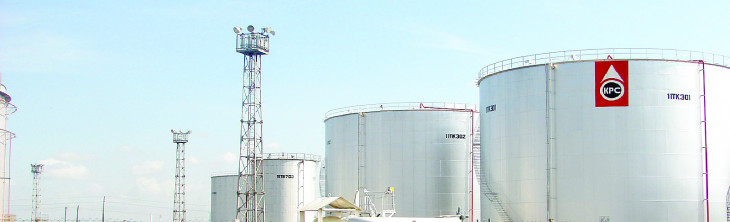
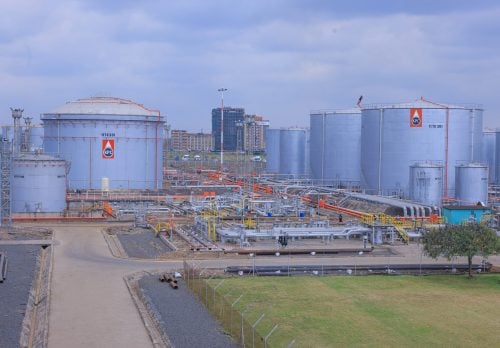
“We are able to see the figures real-time… and as per what we have just seen, it is true that there is quite enough petroleum product in all the KPC depots,” he said after an inspection exercise.
He confirmed that storage facilities in Mombasa, Nairobi, Nakuru, Eldoret and Kisumu have sufficient supply, based on live data from control systems.
“We are satisfied that the country has enough fuel stock,” he added.
Gikaria said the committee will now focus on areas reporting shortages, including Kisii, Nyamira and Migori, despite the Kisumu depot holding adequate volumes. He suggested the issue may lie in distribution rather than supply.
“It is for us now to go and check with EPRA to understand whether the marketers have actually gotten their fuel and taken it to that place,” he said.
He also raised concerns about stock movement, questioning whether some of the fuel held in storage is meant for export rather than local use.
“We could be having a lot of fuel, but maybe part of it is for export,” he noted.
The MP added that oil marketers should move products from depots to retail stations instead of leaving tanks full.
“What we expect is that the local oil companies should have already taken that product… and deliver it to the independent business people,” he said.
As EPRA prepares to announce new prices, the debate now centres on whether the problem lies in taxation, policy choices, or supply chain inefficiencies.
Author
Kenneth Mwenda
Kenneth Mwenda is a business, sports, and politics digital writer with over seven years of experience in journalism, covering breaking news, feature stories, and in-depth analysis across a range of beats.
For inquiries, he can be reached at [email protected]
View all posts by Kenneth MwendaLatest News







Advertisement
More on Business